
In brief: Choose a Unox oven around the food being produced, the tray format, the busiest production window and the team operating it. CHEFTOP is designed around gastronorm-based production, while BAKERTOP is built around bakery formats; capacity, controls, electrical load, water, drainage, ventilation and access should all be settled before a model is ordered.
Choosing a commercial oven can become complicated surprisingly quickly. A conversation that begins with the menu soon turns into tray formats, capacities, steam systems, washing programmes, electrical loads and model codes. The risk is that the technology starts making the decision instead of the kitchen.
With Unox, the useful starting point is not which oven has the longest feature list. It is what the kitchen needs to produce, in what quantity, during which part of the day and with which team. Once those questions are answered, the difference between CHEFTOP, BAKERTOP and the available control platforms becomes much clearer.
This is not a ranking of Unox ovens from basic to best. It is a way of matching the oven to the operation, because a highly capable oven in the wrong format is still the wrong oven.
Start with what leaves the kitchen.
Before comparing oven specifications, write down the products that must come out of it during the busiest service period. Include quantities, batch sizes and required finishing times. A restaurant may need roasted vegetables, steamed fish, regenerated banqueting dishes and several proteins ready at different points in service. A bakery may need successive loads of bread, laminated pastry and confectionery, all using the same tray format but different combinations of heat, airflow and humidity.
The distinction matters because the oven is part of a production system. It needs to work with the trays, racks, preparation benches, proofing equipment, chilling capacity and service routine already around it.
If a combi oven is a new category for the business, our guide to what a combi oven does and how to choose one explains the basic cooking methods and the wider questions to consider.
CHEFTOP or BAKERTOP?
The most important division in the Unox range is practical rather than technological.
CHEFTOP for gastronorm-based production
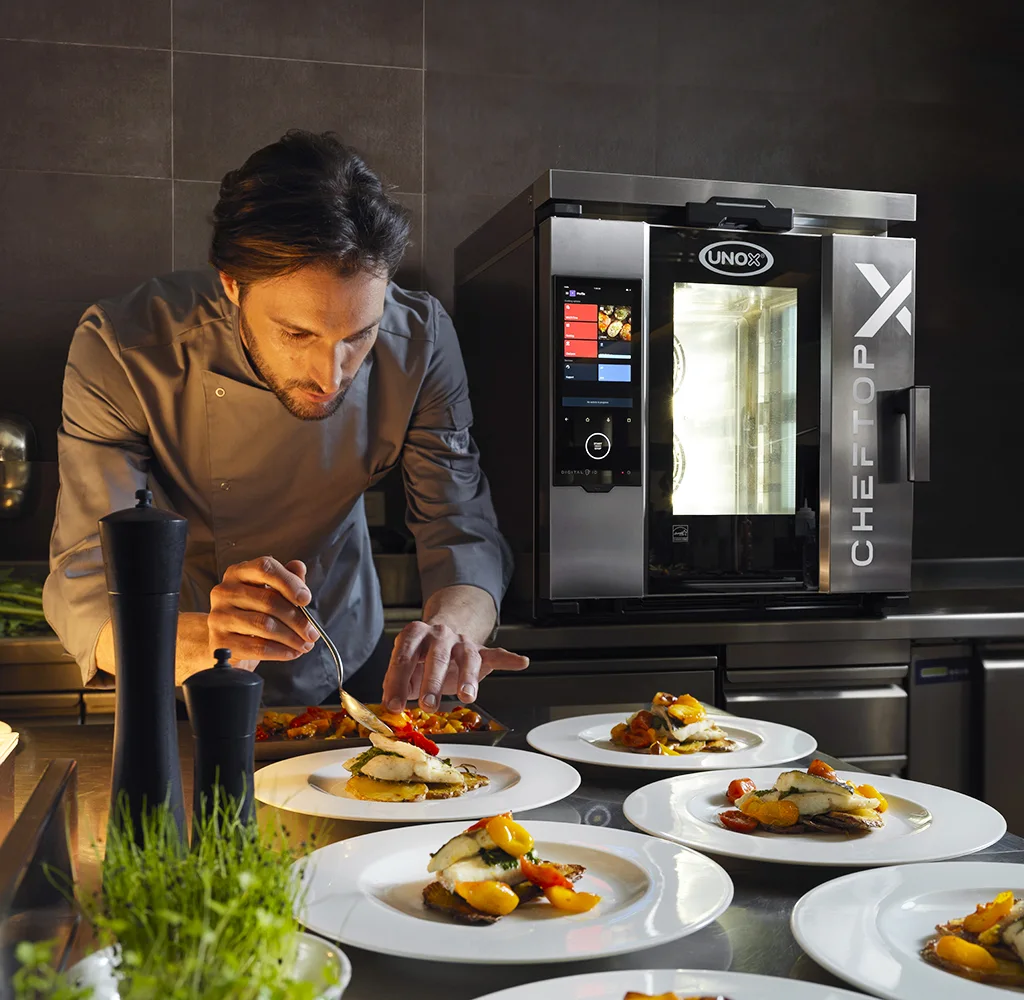
CHEFTOP is organised around gastronorm pans. That makes it a natural fit for restaurant kitchens, hotels, banqueting operations, central preparation and other businesses where the same oven may roast, steam, bake, regenerate and finish different foods over the course of a service.
The menu can still contain bread and pastry. We see that in the Unox CHEFTOP installation at All'Antico Vinaio Valletta, where the oven supports the consistent production of schiacciata. The question is whether gastronorm remains the most useful working format for the wider operation.
BAKERTOP for 600 x 400 mm bakery trays
BAKERTOP is built around the 600 x 400 mm tray format commonly used for bread, pastry and confectionery. It suits bakeries, patisseries, hotel pastry sections and food businesses where baking is a substantial production activity rather than an occasional task.
Tray compatibility is only part of the difference. Bakery work places particular demands on airflow, humidity control and repeatability across a full load. Our article on the BAKERTOP MIND.Maps range looks at those baking requirements in more detail.
Neither family is automatically more capable. They are designed around different working systems. Choosing between them usually becomes easier once the business looks at its trays, products and production route rather than the control panel.
Where the control platform makes a difference
Within both CHEFTOP and BAKERTOP, Unox offers different levels of control and automation. The right level depends on how the oven will be used, how recipes are managed and how much variation exists between shifts.
The MIND.Maps PLUS platform supports stored programmes, multi-stage cooking, humidity management and tools for coordinating several products. This can help a kitchen turn an experienced chef's or baker's method into a repeatable process that another trained team member can follow.
CHEFTOP-X and BAKERTOP-X use the newer Digital.ID platform and add more advanced interaction, monitoring and automated functions. These features can be valuable where the oven handles a wide menu, where consistency across operators is commercially important or where management wants closer visibility of programmes and consumption.
More automation is not automatically more useful. If an operation cooks a small number of stable products, a straightforward programme library may be entirely sufficient. If menus change frequently, several staff use the oven and small variations affect the finished product, the more advanced platform may justify its place.
A useful feature should remove a real variable from production. If the team cannot identify which part of service it improves, it should not decide the specification.
Capacity is a workflow decision
An oven should be sized for the busiest realistic production window, not the quietest average hour and not an imagined future that may never arrive.
Start with the number of trays required during the peak, how long each cycle takes and whether different products can share the chamber without compromising temperature, humidity or flavour. Then look at what happens before and after the oven. A larger model will not solve a shortage of preparation space, trolley capacity, blast chilling, hot holding or staff to load and unload it.
Undersizing creates repeated cycles, slower recovery and pressure at precisely the wrong point in service. Oversizing can mean heating more chamber than the kitchen regularly uses, as well as occupying more space and placing greater demands on the site's utilities.
The most revealing calculation is often trays per peak service period rather than trays per oven load.
Check the site before choosing the model
A model that suits the menu still has to suit the building. Before an order is placed, the site assessment should confirm:
- the available electrical load and whether the proposed model is electric or gas;
- water supply, pressure and the treatment required for the selected oven;
- drainage position and fall;
- ventilation and extraction requirements;
- clearances for heat, airflow, cleaning and servicing;
- the delivery route, including doors, stairs, lifts and final positioning;
- space for stands, trolleys, hoods, filters and other accessories;
- access to isolation points without moving the oven.
These details are not secondary installation matters. They are part of selecting the oven. Discovering that the electrical supply, drainage or delivery route is unsuitable after the equipment arrives is expensive and avoidable.
Water quality and cleaning belong in the decision
Steam production and automatic washing make water quality particularly important. Malta's water conditions mean that filtration or treatment should be considered alongside the oven, not added later as a general-purpose accessory.
The correct arrangement depends on the appliance, the incoming water and the manufacturer's requirements. Our guide to hard water in commercial kitchen equipment explains where scale forms and why one treatment method should not be assumed to suit every appliance.
Cleaning programmes also need to fit the operation. Consider when the oven will be available for washing, who is responsible for checking chemical levels and how the team will record routine care. Automatic cleaning reduces manual work, but it does not remove the need for correct operation, inspection and planned servicing.
Think about the people using it
An oven can only standardise a process that has first been defined properly. During commissioning, recipes need to be tested with the operation's food, trays, load sizes and expected results. Programmes should then be named clearly and unnecessary options kept out of the team's way.
Training should cover more than starting a cooking cycle. Staff need to understand loading, probe use where applicable, programme selection, safe shutdown, daily cleaning and how to report a fault accurately. Managers also need a simple method for controlling who may change established recipes.
This is where specification, installation and after-sales support meet. The best result is not an oven with impressive capabilities on paper. It is an oven the team uses confidently and consistently during a busy service.
A simple Unox oven selection checklist
Before narrowing the model list, answer these questions:
- What products must the oven produce during the busiest service period?
- Does the operation primarily use gastronorm pans or 600 x 400 mm bakery trays?
- How many trays are needed per cycle and across the full peak period?
- Which products need steam, controlled humidity or multi-stage cooking?
- How many people will use the oven, and how consistent are their methods?
- Which automated functions would remove a genuine production variable?
- Are the power, water, drainage, ventilation and access suitable?
- When will cleaning take place, and who will be responsible?
- What happens to service if the oven is unavailable?
- What training, maintenance and local technical support will be in place?
If several of those answers are uncertain, the next step is not to choose a larger model. It is to observe the operation, measure the peak and complete a site survey.
Choosing with confidence
Unox offers enough choice to suit very different professional kitchens, but that choice is only useful when it is tied to the work. CHEFTOP or BAKERTOP, capacity, control platform and accessories should all follow from the menu, tray system, production rhythm, building and people using the equipment.
At Spiteri Catering, we can assess those requirements as one system, from the initial oven choice and site services through to delivery, commissioning, staff guidance and ongoing oven maintenance and technical support.
If you are comparing Unox ovens for a new kitchen or reconsidering an existing production setup, talk to the Spiteri Catering team. We will start with what the kitchen needs to produce and work back to the specification.