
By mid-July, the hottest thing in a Maltese commercial kitchen is rarely the food. It is the air around the stove, where open burners pour heat into the room for every minute of service, whether a pan is on them or not. Induction changes that, and it is why more operators are asking us whether the switch from gas makes sense for their kitchen.
For many kitchens it does, though rarely all at once and rarely for every station. The decision is worth making deliberately, with a clear view of what induction does well, what it asks of the kitchen, and where gas still earns its place.
Induction heats the pan and leaves the room alone.
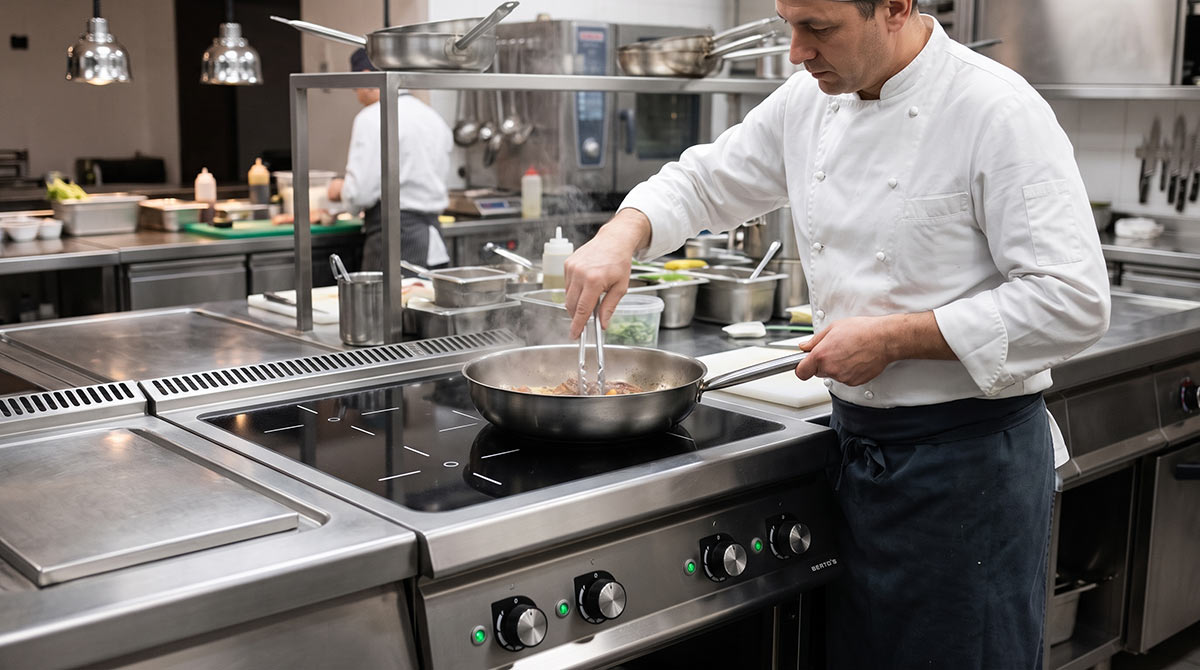
A gas burner heats the air and the pan together, and much of that heat ends up in the kitchen rather than in the food. An induction zone uses a magnetic field to heat the base of the pan directly. The glass surface stays far cooler, and the heat goes where the cook wants it.
The difference is felt most by the team on the line. A cooler kitchen is a more comfortable place to work through a long summer service, and it is easier on everything else in the room: refrigeration beneath the pass works less hard, and so does the air conditioning in an open kitchen. Extraction is still essential because cooking still produces steam, grease, and smoke, but the heat load it has to deal with is lighter. We covered the wider picture of why clean air matters in a commercial kitchen.
Speed and control at the pass
Induction responds the moment the setting changes. Turn it up and the pan reacts straight away; turn it down and the heat drops just as quickly, without the lag of a heavy burner cooling. Water comes to the boil fast, and a sauce can sit at a steady low heat without catching.
Induction also changes the rhythm between orders. A zone only draws power when a pan is on it, so there is no reason to leave burners lit through a quiet spell to keep them ready. When the next ticket arrives, the zone is at full power within seconds.
Gas is on all service. Induction is on only when a pan is on it. Over a summer season, that difference shows up in the kitchen's temperature as much as in the energy bill.
What the switch actually involves
Three practical questions decide how easily a kitchen moves to induction. The first is cookware. Induction needs pans with a magnetic base, so aluminium and copper pans without a suitable base will need replacing. Most professional stainless steel and cast iron pans already work, and a simple magnet test tells you quickly what can stay.
The second is electrical supply. Higher-powered induction units draw significant current, and some of our heavier units, such as the 5 kW tabletop induction cooker, run on a 400 V supply. Before any installation, the kitchen's supply needs checking against what is planned, and in some buildings that means an upgrade.
The third is the team. Chefs who have cooked on gas for years read a flame by eye. Induction takes a short adjustment to power settings in place of flame height, and most teams settle into it within a few services.
Start with one station.
The most practical route for most kitchens is gradual. Replacing a single station lets the team learn induction during real service, and it spreads the cost of any electrical work. A tabletop unit is the simplest starting point. Our equipment range includes CaterChef tabletop induction hobs from 2.7 kW single-zone plates with 15 power levels, through a two-zone model rated up to 3.5 kW, to the 5 kW 400 V cooker for heavier work, alongside built-in induction hobs for counter installation.
For kitchens ready to go further, the 4-zone induction cooker with square cooking areas brings a full range to the line, with four zones in place of a four-burner gas top. Where space is tighter, or where a kitchen wants to convert one section at a time, the 2-zone induction cooker does the same job on a smaller footprint. We also supply drop-in induction plates with two 220 mm cooking zones at 5 kW, designed to sit within a cooking line, and a 30 litre induction fryer on a closed cabinet. Frying is a strong candidate for induction because the oil comes back to temperature quickly between batches, which matters most when the fryer is working hardest.
Where a full kitchen refit is planned, induction is best considered at the design stage, when the cooking line, electrical layout, and extraction can be planned together. Our guide to planning a commercial kitchen in Malta sets out how those decisions fit together.
Where gas still earns its place
Induction suits most cooking, but some menus still lean on a flame. Wok cooking relies on heat curling around the sides of the pan, and charring or flame finishing needs fire. Many kitchens settle on a hybrid line, with induction for boiling, sauces, and frying and gas kept for the stations that genuinely need it. That balance often gives the team the comfort and control of induction without changing the character of the menu.
Frequently asked questions
Will my existing pans work on induction?
Pans with a magnetic base will work, which includes most professional stainless steel and cast iron. If a magnet sticks firmly to the base of the pan, it is suitable. Aluminium and copper pans without an induction base will need replacing.
Do I still need extraction with induction?
Yes. Induction reduces the heat in the kitchen, but cooking still produces steam, grease, and smoke that extraction has to remove. The system may have less heat to manage, but it remains a requirement.
Does my kitchen need an electrical upgrade?
It depends on the equipment and the existing supply. Smaller tabletop units run from a standard supply, while higher-powered plates and cookers may need a 400 V connection. We check the supply against the planned equipment before installation.
Can I mix gas and induction in the same kitchen?
Yes, and many kitchens do. A hybrid line lets you move boiling, sauces, and frying to induction while keeping gas for wok work or charring, and it allows the switch to happen gradually.
If you are weighing up induction for your kitchen, whether for a single station or a full cooking line, we would be glad to talk it through. Get in touch with the Spiteri Catering team and let us understand what you need. We handle everything from initial consultation and design through to supply, professional installation, and ongoing technical support.
Related reading: Clean Air Is Not a Luxury in a Commercial Kitchen | How to Plan a Commercial Kitchen in Malta | Getting Your Commercial Kitchen Ready for Summer