
The Hidden Cost of the Wrong Dishwasher
The purchase price is the number most operators remember. It is also, over the life of a commercial dishwasher, one of the smaller figures in the story.
Water, energy, detergent, rinse aid, chemicals, engineer call-outs, replacement parts, and the compounding cost of a machine that cannot keep pace with service: these are the numbers that accumulate quietly, month after month, in ways that rarely get totted up until something goes wrong. This post is about making that calculation visible, and about what it means for the equipment decisions in front of you.
Water consumption
A commercial dishwasher uses water on every cycle. The question is how much, and whether that figure is appropriate for the volume of covers the machine is processing.
An undercounter machine running light loads through a busy service is cycling more frequently than a correctly sized hood machine would need to. Each additional cycle is additional water. Over a full service, over a week, over a summer season in a Maltese kitchen running at capacity, those cycles add up to a meaningful cost that sits entirely outside the purchase price.
Water consumption also interacts with Malta's hard water supply in a specific way. Higher water usage means more mineral contact, which means faster limescale build-up, which means more frequent descaling, more chemical usage, and greater wear on internal components. A machine specified for a lower volume than it is actually processing compounds its own running costs in ways that are not always obvious until the problems appear.
Energy
The wash cycle requires heat. Maintaining wash tank temperature at 60°C and rinse temperature at 90°C across continuous service cycling is an energy demand that runs whether the machine is processing a full rack or a half-empty one. A machine that is undersized for its volume runs more cycles to process the same throughput; a machine that is oversized for its volume heats water it does not fully use.
Neither scenario is efficient, and in a commercial kitchen running ten or eleven months of peak service in the Maltese climate, energy inefficiency is a running cost that compounds across every service.
Modern warewashing equipment from manufacturers such as Krupps and Aristarco is engineered with energy recovery and thermal efficiency in mind. The difference between a well-specified current machine and an older or incorrectly sized unit can be substantial when measured across a full trading year.
Chemicals
Detergent and rinse aid consumption are directly linked to cycle count and water hardness. A machine running more cycles than necessary uses more of both. A machine struggling with limescale build-up often prompts operators to increase detergent dosing in an attempt to compensate for declining wash quality, which increases chemical spend without addressing the underlying cause.
Chemical costs are easy to absorb individually. They are less easy to absorb when viewed cumulatively. An operator running a busy kitchen through a full year of service may find that chemical spend over twelve months exceeds what they initially paid for the machine. That is not an unusual outcome for a machine that has been in service for several years without review.
Downtime
A dishwasher that stops mid-service is not an inconvenience. It is an operational crisis. Clean crockery, glassware, and utensils are prerequisites for service; without them, the kitchen stops regardless of how well everything else is working.
The cost of downtime is rarely captured in maintenance budgets because it does not appear as a line item. It appears instead as a service that slows, as guests who wait, as staff who improvise under pressure, and occasionally as a service that has to be curtailed entirely. For a kitchen that has outgrown its machine or is running equipment past its reliable service life, that risk is present at every service.
Reliable warewashing equipment, correctly specified and properly supported, removes that risk. It is one of the more straightforward investments a commercial kitchen can make, and one whose value is most clearly understood by operators who have experienced the alternative.
The throughput problem
Every commercial dishwasher has a rated throughput: a maximum number of baskets per hour under standard operating conditions. What that figure does not always convey is what happens when a kitchen consistently runs at or above that rate.
A machine operating at the top of its capacity produces acceptable results under ideal conditions. In a hot kitchen in summer, with hard water, repeated door openings, and back-to-back cycles through a long service, the margins narrow. Wash quality drops before operators notice. Rinse temperatures take longer to recover. The machine that worked adequately in spring becomes a liability by August.
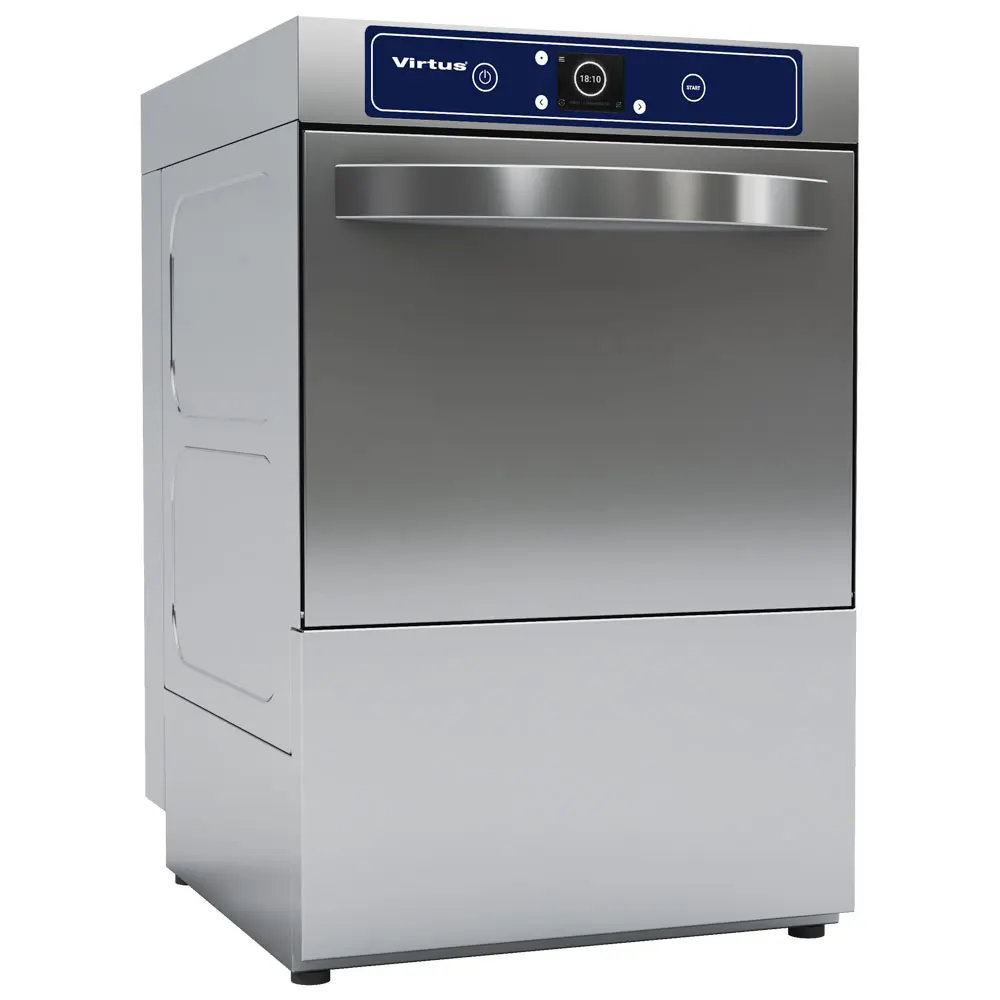
The Virtus VSGLB0140 is a glasswasher built with these conditions in mind. Its 40x40cm rack format, electronic controls, and thermostatic management of both wash at 60°C and rinse at 90°C deliver consistent results across cycle options of 90, 120, and 180 seconds, with a maximum output of 40 baskets per hour. The double-wall door construction reduces heat loss and operating noise, which matters in any kitchen where the bar or service counter is close to the wash area. It is the kind of machine that earns its keep quietly, provided it is correctly matched to the volume it is being asked to handle.
The right machine for the volume
Most warewashing problems in commercial kitchens are not equipment failures. They are specification failures: a machine chosen for its footprint or its price point rather than for the actual throughput demands and warewashing flow of the operation it serves.
Krupps has built a strong reputation for reliable undercounter dishwashing equipment suited to compact commercial kitchens, combining fast cycle times with genuine energy efficiency. Aristarco, an Italian manufacturer with a broad warewashing range, covers the fuller spectrum from undercounter units through to higher-capacity hood machines for kitchens with greater throughput demands. Both brands approach the specification question seriously, which is why we work with them.
The question worth asking is not what machine fits the space. It is what machine fits the volume, and whether the two answers are the same.
If you are running warewashing equipment that is several years old, or equipment that was specified for a volume your kitchen no longer operates at, the running costs you are carrying may be higher than they need to be. It is worth finding out.
Get in touch with the Spiteri Catering team and let us understand what you need. We handle everything from initial consultation and design through to supply, professional installation, and ongoing technical support.
Frequently asked questions
Questions we hear often from operators reviewing their warewashing setup.
How do I know if my dishwasher is costing me more than it should?
The clearest signs are rising chemical consumption, frequent engineer call-outs, declining wash quality during peak service, and a machine that regularly struggles to keep pace with throughput. Any one of these warrants a conversation about whether the equipment is still correctly specified for the volume it is handling.
How often should a commercial dishwasher be replaced?
There is no fixed answer, because it depends on the quality of the original equipment, how well it has been maintained, and whether the volume it is handling has changed since it was installed. A well-maintained machine from a reputable manufacturer, correctly specified for its workload, can serve reliably for many years. The more useful question is whether your current machine is still performing to the standard your operation requires.
Does Malta's hard water really make a significant difference to running costs?
Yes, meaningfully so. Hard water accelerates limescale build-up on heating elements, spray arms, and internal surfaces. This reduces wash and rinse efficiency, increases energy consumption as heating elements work harder, drives up chemical usage, and shortens component life. Regular descaling and correct water softener dosing are not optional extras in the Maltese market; they are basic maintenance requirements.
What is the difference between a glasswasher and an undercounter dishwasher?
A glasswasher uses a smaller rack format, gentler wash pressures, and lower temperatures to protect glassware from thermal shock and physical damage. An undercounter dishwasher handles the broader range of crockery, utensils, and small equipment a kitchen produces. Most operations need both, positioned where the volume of each type of ware is generated.
Is it worth investing in a newer machine if my current one is still technically working?
Often, yes. Warewashing technology has improved considerably in terms of energy and water efficiency. A newer, correctly specified machine will typically reduce water consumption, lower energy use, cut chemical spend, and require less maintenance than an older unit running beyond its optimal service life. The running cost savings can offset the capital cost of replacement more quickly than most operators expect.
Related reading: Planning a Dishwashing Area That Does Not Interrupt Service | Why Maltese Caterers Are Turning to the Krupps KE50UT Dishwasher | Essential Maintenance for Your Glasswasher and Dishwasher | Getting Your Commercial Kitchen Ready for Summer