

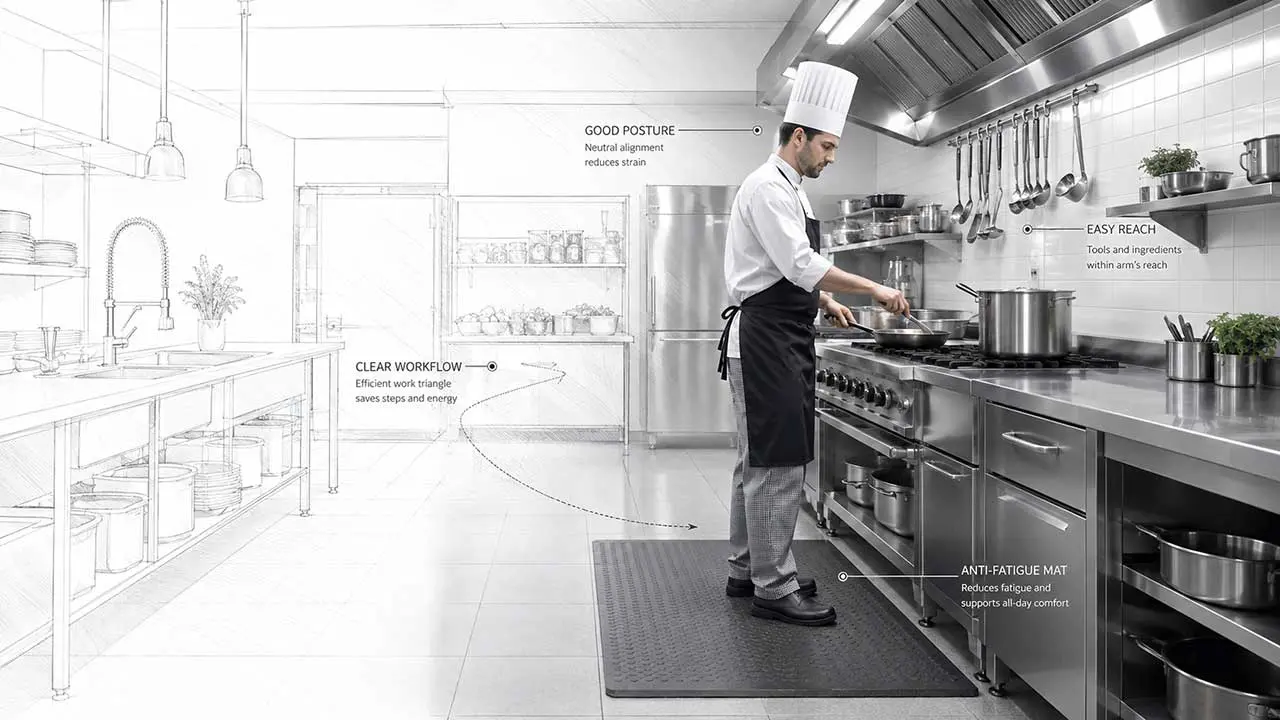
Every kitchen we design starts with the same conversation: what does this operation need to produce, and how many people will be working in here at once. The brief is usually about output. Covers, throughput, menu complexity, service speed. Those are the right questions to start with. But sitting alongside them, from the very first site visit, is a question that operators sometimes raise and sometimes do not: what will this kitchen be like to work in, every day, for the people whose labour makes it run.
It matters more than the specification meetings tend to suggest. Commercial kitchens have some of the highest staff turnover rates of any industry, and a meaningful portion of what drives people out is avoidable. It starts with how the kitchen was designed and what it asks of the people inside it.
What a poor layout actually costs
A chef working a busy service in a badly designed kitchen does not just work harder. They work differently, compensating constantly for a space that was not built around how work actually flows. They reach further, turn more often, walk greater distances between positions, and hold postures that load the lower back and shoulders in ways that accumulate over a shift. Over weeks and months, that accumulation produces the musculoskeletal problems that account for a substantial share of sick days across the hospitality industry.
The less visible cost is cognitive. A kitchen where the prep position sits too far from the cooking line, or where the pass is awkwardly placed relative to service, forces constant small adjustments. None is serious on its own. Collectively, they add to the mental load of a shift that is already demanding. Staff who finish a service exhausted rather than tired are staff who start looking for work elsewhere.
The layout of a kitchen is a set of daily instructions to the people who work in it. A good layout says: this space was built around how you work. A poor one says: work around the space.
When we carry out a site assessment as part of our kitchen design process, we are measuring more than dimensions. We are understanding where the work actually happens: where prep ingredients need to be when the cooking starts, where the dirty ware goes, how many people will cross each other's paths during a service and how often. The floor plan that comes out of that process reflects those realities, not just the equipment footprint.
Working height and reach
Working height matters more than most operators realise when specifying a kitchen. Standard counter height suits a standing person performing light tasks. A chef who preps for three hours or works the line through a full service is doing sustained, physical work, and the right height for that work is typically slightly lower than the default: low enough to keep the elbows close to the body rather than raised. That one consideration, applied consistently across prep and cooking positions, reduces shoulder and neck fatigue measurably over the course of a shift.
We factor this in when we are specifying cooking lines and fabrication. The Bertos Macros and S900 series, which anchors a large proportion of the restaurant kitchens we install, is available in configurations that allow us to set working surfaces at the right height for the kitchen and the team using it. Neutral fabrication from Combisteel follows the same logic. The spec is not just about the equipment; it is about what the equipment asks of the person standing in front of it for ten hours. That principle reaches right down to choosing cookware that remains manageable through service, particularly when a vessel is repeatedly lifted, poured and returned to the line.
Heat, air, and the Maltese summer
Malta's summers make the thermal environment of a commercial kitchen sharper than it would be elsewhere. An ambient temperature that is already high before the cooking equipment comes on means extraction and ventilation are occupational health requirements, not comfort considerations. A kitchen that is properly designed for the Maltese operating environment takes that starting point seriously from the outset, specifying extraction capacity around the actual output of the equipment and the actual conditions the kitchen operates in.
Extraction systems sized correctly for the cooking line beneath them keep the kitchen clear of heat, steam, and combustion byproducts throughout a service. Systems that were undersized or incorrectly positioned do not, and the people who absorb the difference are the ones working the line. We size extraction canopies to the cooking positions we install, not to a round number. The balance between extraction capacity and equipment output is something we return to at every design stage, because getting it wrong costs energy, comfort, and eventually staff.
The placement of refrigeration follows a related logic. Cold storage positioned close to the cooking line and the prep station reduces unnecessary movement during service. That is an efficiency argument, but it is also a physical one: fewer journeys mean less time on feet already under load, and less repeated exposure to the temperature transition between cooking and cold zones. In the restaurant installations we complete, this consideration shapes how we position Combisteel and Infrico refrigeration relative to the cooking line from the start of the floor plan, not as an afterthought once everything else is placed.
Aisle widths and how people move
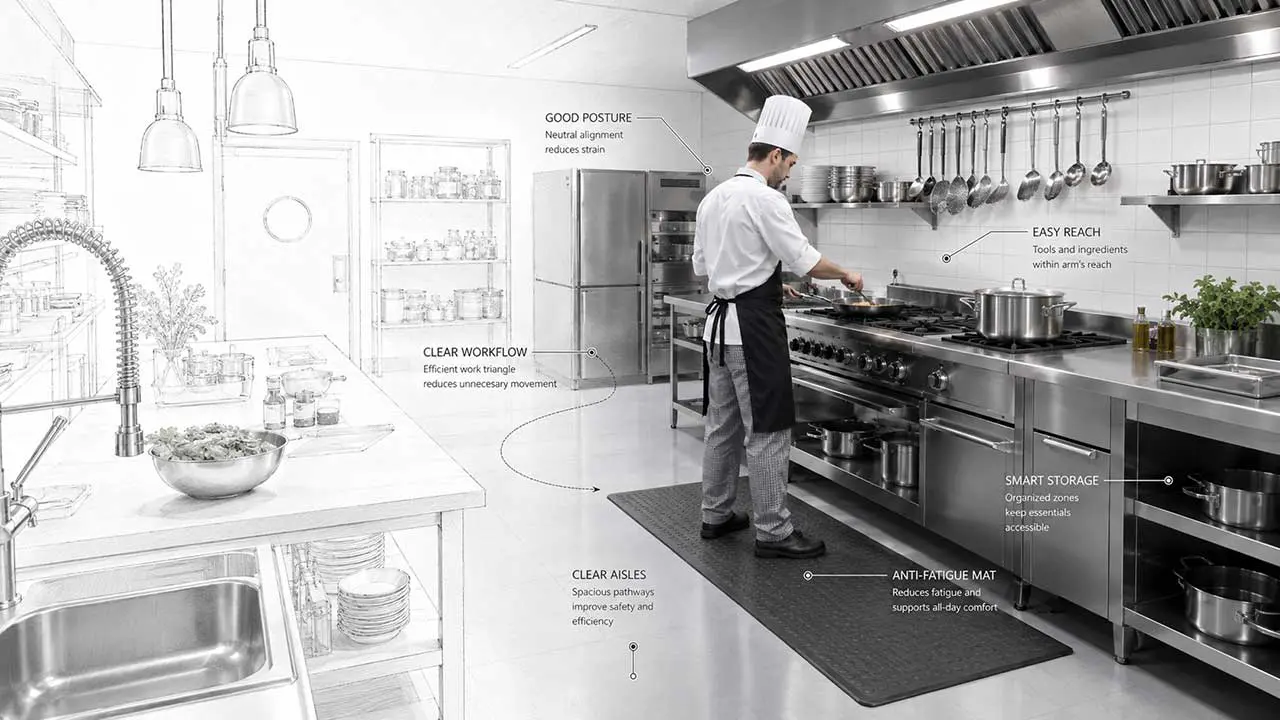
Aisle widths determine whether two people can work past each other safely, and whether the instinctive response to a busy service is to rush through a narrow gap carrying hot equipment. The minimum for a single-cook aisle is workable. The minimum for a multi-person kitchen is wider, and the difference between a kitchen designed to code and one designed to be used shows up fastest in how staff move under pressure. A kitchen where people are regularly in each other's way is a kitchen where accidents happen and where the tension of a busy service is amplified by the space.
This is one of the reasons we invest time in the floor plan before anything is specified. On paper, a kitchen can look workable. Walked through with service conditions in mind, the same kitchen can reveal pinch points, blind corners, and aisle widths that feel generous until two people are moving through them at once. The 3D visualisation we produce as part of our kitchen design process is partly an aesthetic tool, but it is also a practical one: it lets the operator and the team understand the space before any equipment is ordered.
Noise and the less obvious stressors
Commercial kitchens are loud. Extraction fans, dishwashers, combi ovens on cycle, the general noise of a service in progress. Some of that noise is unavoidable. Some of it is a function of how equipment was specified and positioned. An extraction fan running at maximum because it was not sized correctly for the cooking load creates a constant background level that staff adapt to over time, which means they raise their voices to communicate and absorb the auditory fatigue without necessarily identifying it as a source of exhaustion.
These considerations rarely come up in a standard equipment discussion. They emerge from a design process that starts from the people working in the space rather than from the equipment that needs to fit in it. Dishwashing positioned in a dedicated zone rather than open to the main kitchen reduces cycle noise during service. Extraction sized correctly runs quieter and keeps the kitchen cleaner. These are details that accumulate into the daily experience of working in a kitchen, and they are worth thinking through at the design stage, when changing them is straightforward, rather than after the fit-out is complete.
Design as retention
What a well-designed kitchen cannot do is fix pay or culture. What it can do is remove a category of daily friction that wears down staff who might otherwise stay: the back pain that builds through a service, the frustration of a layout that works against the team, the heat that should have been better managed, the noise that makes communication harder than it needs to be.
A kitchen that works well for the people inside it tends to work well for the operation overall. The two are not in tension. They are the same design problem viewed from a different angle.
We have fitted out kitchens of every scale across Malta, from small restaurant builds to large hotel operations, and the ones that run well over time are consistently the ones where the brief took these questions seriously from the start. The spec matters. The brands matter. The installation matters. But the layout is where it begins, and a layout built around the people working in it is an investment that pays back every service.
If you are planning a new kitchen or refitting an existing one and want to think through the brief properly, we are glad to help. Get in touch with the Spiteri Catering team and tell us what you are working with. We cover everything from initial consultation and design through to supply, professional installation, and ongoing technical support.
Related reading: How to plan a commercial kitchen in Malta | Clean air is not a luxury in a commercial kitchen | From Blank Canvas to Working Kitchen: The Zigumar Restaurant Fit-Out