


The season does not announce itself. One week the bookings are manageable; the next, every cover is taken, and the kitchen is running at a pace it has not touched since last September. The equipment that has been ticking over quietly through the winter months is suddenly working harder than at any other point in the year, in ambient temperatures that compound every existing weakness.
The time to look at that is now, before the pressure arrives. This post works through the main equipment categories in a commercial kitchen and covers what is worth checking ahead of summer. It is not a substitute for a service call; it is the argument for booking one.
Why summer is different in Malta
Most commercial kitchen equipment is engineered and rated for a temperate European climate. Malta in July and August is not that. Kitchen ambient temperatures routinely exceed 35°C in back-of-house spaces, and in poorly ventilated kitchens they can go higher. Every piece of equipment in the kitchen is working against that baseline: refrigeration units are running longer cycles, ovens are cycling more heat into an already hot room, extraction systems are handling heavier grease loads, and dishwashers are running more frequently than the machine was specced for on a quiet Tuesday in February.
Layer a full tourist season on top of that and the conditions become genuinely demanding. Covers that might average forty in April can easily reach a hundred and forty in August. The throughput increase does not give equipment more time to recover between uses. It does the opposite. A machine that was performing adequately in May will show its weaknesses in August, usually at the worst possible moment.
The case for a pre-season review is not about being cautious. It is about being practical. A planned service check costs a fraction of what an emergency breakdown costs: not just the repair but also the lost service, the wasted product, and the stress of trying to resolve a technical problem mid-shift in the middle of high season.
Refrigeration
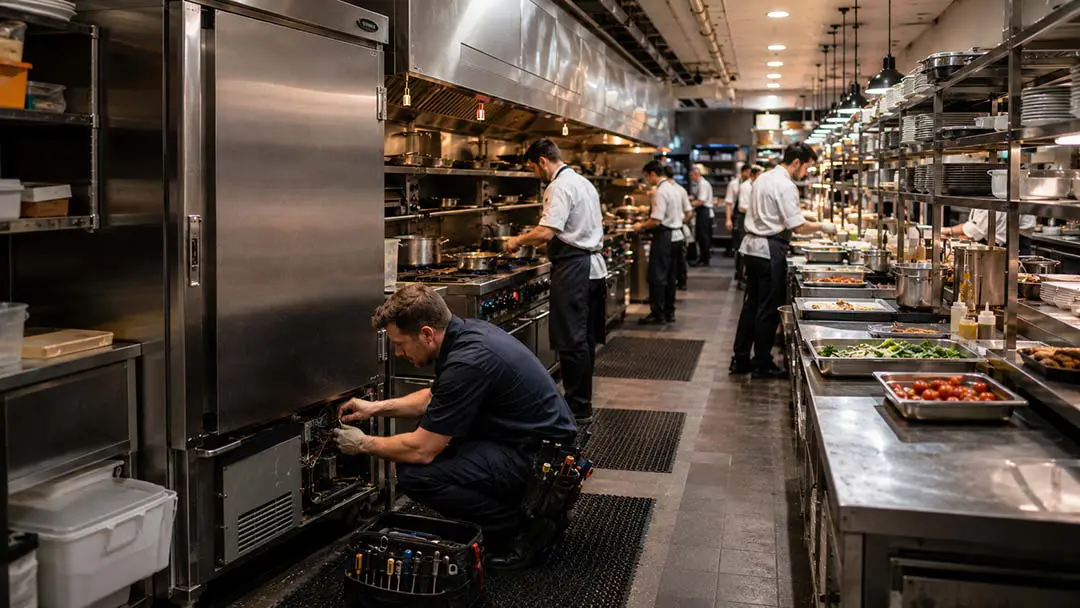
We have covered commercial refrigeration and summer in detail already, so we will keep this brief here. The short version: summer puts refrigeration under more pressure than any other season. Condensers accumulate dust and grease through the quieter months; door seals degrade gradually, and the degradation becomes critical when ambient heat is high; units without adequate clearance and ventilation run hotter, consume more energy, and wear faster than their ratings suggest.
A pre-season service check on refrigeration should cover the condenser coil, door seals, temperature calibration, and clearance. If the unit is already showing signs of struggle, such as temperature drift, longer recovery times, or audible compressor strain, that is not a dial adjustment. That is a service call, and the right time for it is before the season, not during it. For the full detail on what to check and why, the refrigeration and summer advisory covers it thoroughly.
Cooking equipment
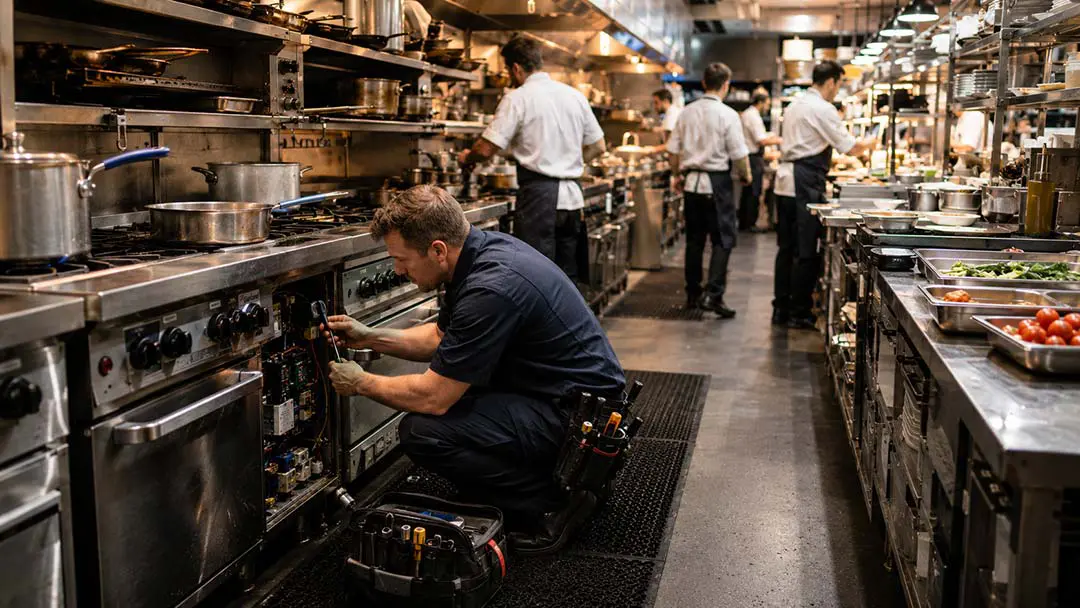
Combi ovens and convection ovens are among the hardest-working pieces of equipment in a commercial kitchen. They run long hours, cycle through high temperatures repeatedly, and, in many operations, they are never fully off. Summer does not change what they need, but it does change what happens when those needs are not met.
The areas worth checking before the season are the door seals, the steam system on combi models, and the cleaning and descaling history. A door seal that is compromised loses heat and forces the oven to work harder to maintain temperature; in a kitchen already running at 35°C ambient, that inefficiency adds up quickly. Combi ovens with a steam injection or boiler system accumulate limescale over time, and Malta's hard water accelerates that process. An oven that has not been descaled will run less efficiently, consume more energy, and put its heating elements under greater strain precisely when the demand on it is highest.
Cleaning cycles matter too. An oven with a build-up of grease or carbonised residue in the cavity holds heat less evenly, takes longer to reach target temperature, and creates a hygiene risk that becomes harder to manage during a busy service. Most modern combi ovens include an automatic cleaning programme; making sure it is being used consistently is as important as the machine itself. The oven maintenance guide covers the full routine in detail.
Dishwashing
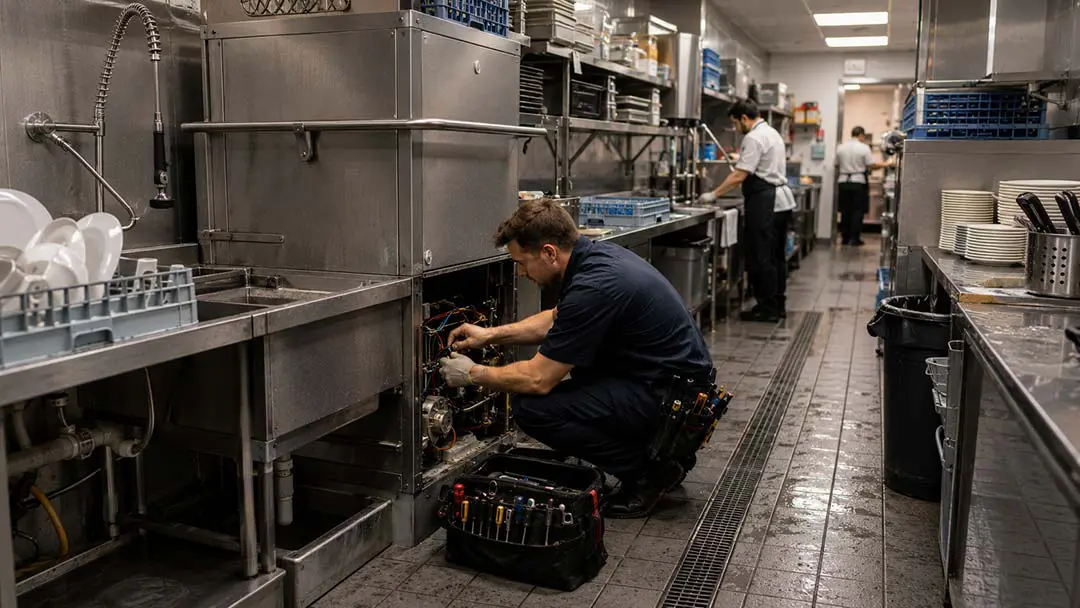
Dishwashing is easy to overlook in a pre-season review. The dishwasher runs, the glasses come out clean, and nothing has obviously broken. But summer changes the equation significantly. More covers mean more cycles. More cycles mean faster scale build-up, higher water and chemical consumption, and more heat generated in an already warm space. A machine that was cycling at a manageable rate in March will be running almost continuously in August, and the maintenance requirements scale with that.
Malta's water hardness compounds this. Hard water accelerates limescale accumulation in the wash tank, on the heating element, and in the spray arms. A machine that is not being descaled regularly will lose wash temperature, reduce hygiene performance, and eventually fail earlier than it should. The pre-season check for dishwashing is straightforward: inspect the spray arms for blocked jets, check the wash and rinse temperatures against the machine's specified range, and confirm the dosing system is delivering the correct amounts of detergent and rinse aid. If the machine has not been professionally serviced within the last twelve months, now is the right time.
A dishwasher that goes down mid-service in August is one of the most disruptive failures a kitchen can face. There is no improvised workaround when the volume is that high. For a fuller picture of what dishwashing actually costs to run and where the losses accumulate, the post on what your dishwasher is actually costing you is worth reading before the season starts.
Extraction and ventilation
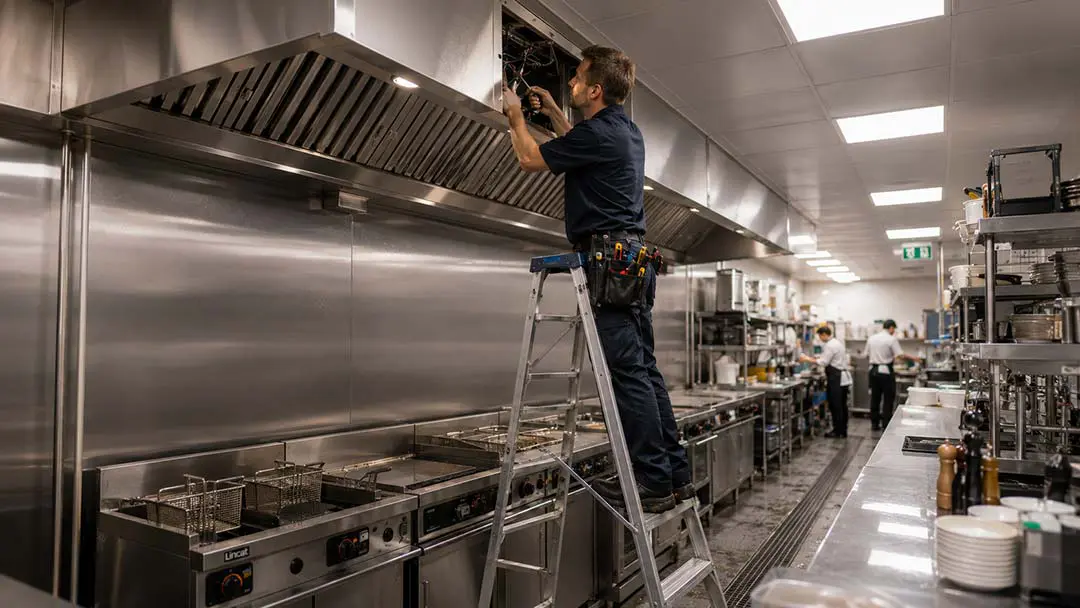
Extraction is the category that suffers most visibly from deferred maintenance and the one where the consequences extend furthest beyond the equipment itself. A canopy that is not removing heat, steam, and grease efficiently makes the kitchen hotter, more uncomfortable, and harder to work in. In summer, that effect is amplified. A kitchen that was borderline in spring becomes genuinely unpleasant in July, and an uncomfortable kitchen is a less safe and less productive one.
The grease filters in an extraction canopy accumulate quickly in a working kitchen. Filters that are saturated with grease do not just underperform; they represent a fire risk. Cleaning frequency should increase in line with kitchen output, and a pre-season check should confirm that filters are clean, that the fan is running at the correct speed, and that the ductwork is not carrying an excessive grease load. If the extraction system has not been inspected or cleaned professionally since last summer, that should be addressed before the season begins.
A kitchen's extraction system is doing its job best when nobody notices it. When staff are hot, steam is hanging in the air, and cooking smells are travelling front of house, the extraction is already failing. Summer is not the time to discover that.
For operators who are uncertain whether their extraction capacity is adequate for the volumes they are running, the advisory post on why proper kitchen extraction design matters covers the principles behind sizing and performance in detail.
One team, one kitchen
The categories above are distinct. Refrigeration, cooking, dishwashing, and extraction each have their own service requirements, their own failure modes, and their own consequences when they go wrong. But a commercial kitchen does not fail in categories. It fails as a system. A refrigeration unit that is struggling and a dishwasher that is underperforming and an extraction canopy that is half-blocked are each a problem on their own; together, they describe a kitchen that is going into its busiest season in a weakened state.
The value of having one team who knows the full picture is that the conversation is different. Not "the fridge is making a noise", but "here is the current state of the kitchen, and here is what we think needs attention before August." That wider view is what makes the difference between reactive maintenance and a kitchen that runs through the season without drama.
Our technical support team covers all of the categories above. For equipment we supplied and installed, we hold the service history and know the kit. For equipment we did not supply, we can carry out an assessment and give an honest view of what is worth carrying into another season and what is not. Either way, the right time for that conversation is before the heat arrives.
If you would like to discuss your kitchen's maintenance schedule ahead of the summer season, we would be glad to hear from you. Get in touch with the Spiteri Catering team and let us understand what you need. We handle everything from initial consultation and design through to supply, professional installation, and ongoing technical support.
Related reading: Summer is hard on refrigeration | The parts are here. The team is ready. | What your dishwasher is actually costing you