

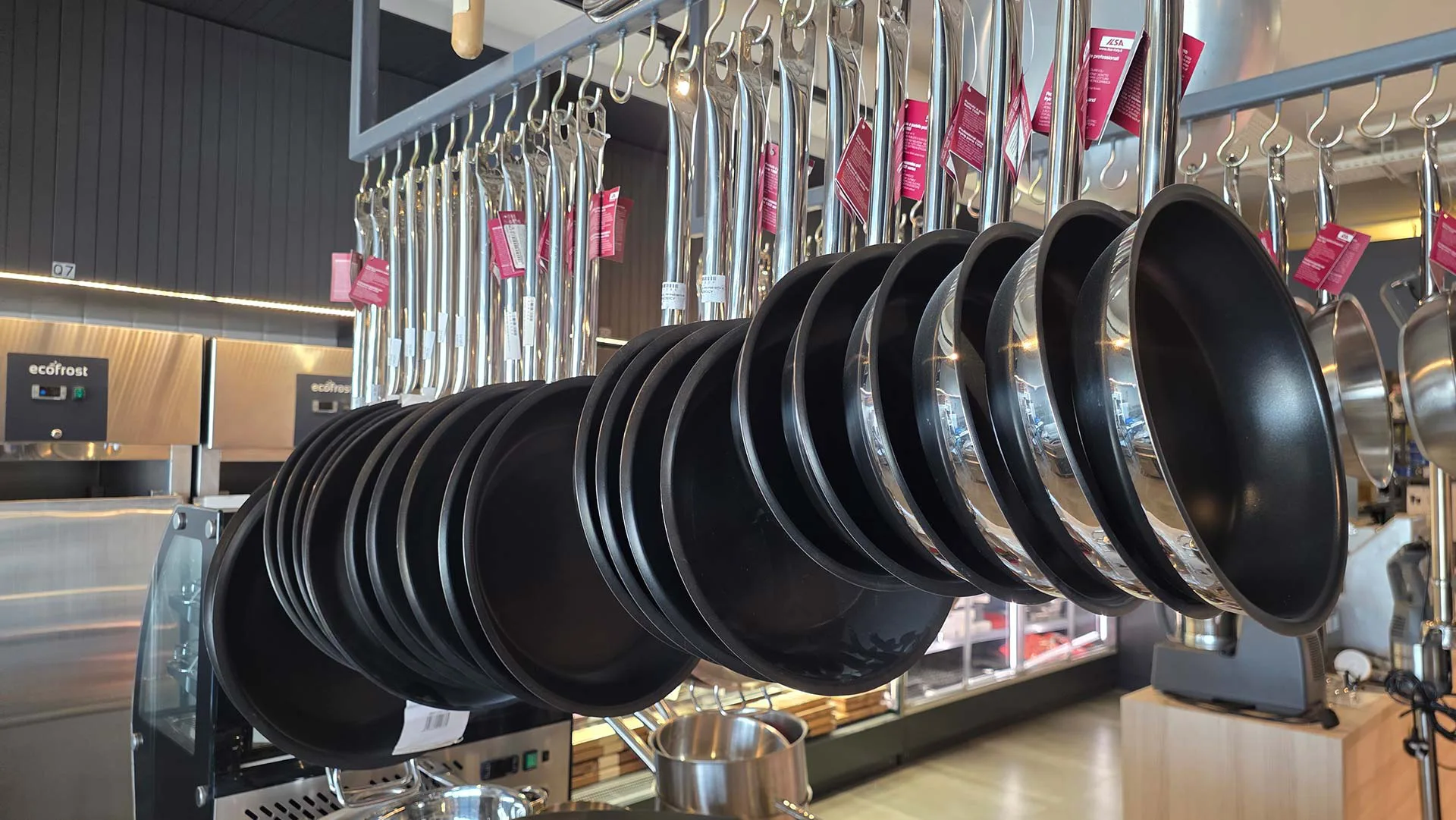
In brief: Choose professional cookware around the cooking task, heat source, batch size and person handling it, not as a generic set. Material, base construction, vessel shape, handle design and filled weight all affect service, while the quantity purchased should cover peak production and washing turnaround. Cleaning, seasoning, storage and inspection requirements belong in the buying decision.
A pan can look perfectly serviceable on the shelf and still become the wrong tool as soon as the first orders arrive. It may take too long to respond, lose heat when a batch goes in, feel unnecessarily heavy by the end of the shift or demand more careful handling than the team can realistically give it.
That is why professional cookware should be chosen in much the same way as the wider professional cookware range. The starting point is not the finish or the brand name. It is the work the item must do, the heat source beneath it, the person handling it and the pace at which it must return to service.
For restaurants, hotels, bakeries and catering operations in Malta and Gozo, a well-planned cookware set can improve consistency without filling the kitchen with every possible size and shape. The aim is a smaller, more useful collection in which every item earns its place.
Start with the work, not the material
Stainless steel, carbon steel, aluminium and non-stick cookware behave differently, but material alone does not make a pan suitable. Before comparing ranges, look at the production task.
A kitchen preparing sauces to order needs controlled response and comfortable handling. A high-volume operation producing stocks, soups or pasta needs capacity, stable bases and handles that remain manageable when the vessel is full. A breakfast station may value fast turnaround and easy release, while a meat section may prioritise high-temperature searing and heat retention.
Ask five practical questions for each station:
- What dishes will be cooked in it most often?
- What is the largest realistic batch during peak production?
- Will it be used on gas, electric, ceramic or induction?
- How often must it be cleaned and returned to the line?
- Who will lift, pour, carry and store it during a working shift?
This is the same operational approach we use when planning a commercial kitchen. Capacity, workflow and staff movement should lead the specification.
What the main cookware materials do well
Stainless steel for dependable everyday use
Stainless steel is a sound general-purpose choice for professional kitchens. It is durable, easy to clean and suited to a broad range of cooking tasks. It is particularly useful where cookware moves repeatedly between preparation, cooking and washing throughout the day.
The base construction matters. In the Pujadas Inox-Pro range, for example, the stainless steel body is paired with a sandwich base containing an aluminium core. Pujadas specifies this construction for faster, more even heat distribution and induction compatibility. In practice, this helps address one of the weaknesses of a simple stainless steel vessel: stainless steel is robust, but it is not valued for rapid heat conduction on its own.
Stainless steel is not automatically non-stick. Temperature control, sufficient preheating and the right amount of cooking fat still matter. This makes it versatile rather than effortless, and it suits teams that understand how to manage the pan.
Carbon steel for searing and responsive cooking
Carbon steel is useful where strong heat response and a naturally seasoned cooking surface are valuable. It can work particularly well for searing, sautéing and other fast cooking tasks. Pujadas offers carbon-steel frying pans and woks within its professional range, including induction-compatible options.
The trade-off is care. Carbon steel should be seasoned according to the manufacturer's instructions, cleaned without stripping the working surface unnecessarily and dried promptly. Prolonged exposure to acidic ingredients can also disturb the seasoning and affect the cooking result. It is a strong service tool when the kitchen is prepared to look after it, but a poor choice if it will routinely be left wet at the end of a shift.
Aluminium when weight and quick response matter
Aluminium cookware is comparatively light and responds quickly to changes in heat. Those qualities can reduce effort at a busy station and make temperature adjustments more immediate.
Construction and surface treatment must still be checked. Not every aluminium item is suitable for every food, cleaning method or heat source, and standard aluminium is not inherently induction-compatible. Where induction is used, compatibility should be confirmed for the exact model rather than assumed from its appearance.
Non-stick for the right controlled task
A non-stick surface can be helpful for eggs, delicate fish and other foods where easy release is important. It should not become the default pan for every job. High heat, unsuitable utensils and abrasive cleaning shorten the useful life of many coatings.
Use non-stick cookware at the station where it has a clear purpose, follow the manufacturer's temperature and utensil guidance, and treat the coating as a working surface that must be inspected. Once it is damaged or deteriorating, the pan should be reviewed rather than kept in service indefinitely.
Choose the shape as carefully as the material
Two vessels made from the same material can perform very different jobs. A stockpot provides depth and capacity for liquids. A wide casserole or sauce pot increases surface area for reduction and gives better access for stirring. A sauté pan offers a broad base with straighter sides, while a frying pan makes tossing, turning and evaporation easier.
Diameter alone can also be misleading. Check usable capacity, base diameter and overall height. A large pan with a base that extends beyond the effective heating zone may cook less evenly than a smaller one properly matched to the hob.
Handles deserve equal attention. A vessel may be comfortable when empty but awkward when filled with sauce, stock or oil. Loop handles can make larger pots easier to support with two hands, while a long tubular handle may suit a saucepan used for controlled pouring. Staff should have room to grip the cookware safely without neighbouring handles projecting into the working route.
Match cookware to the cooking line
The move towards induction makes compatibility an important purchasing check, but a magnetic base is only the beginning. The cookware must also suit the size and output of the zone. On gas, consider flame spread and whether handles or neighbouring items will sit in the heat path. On ceramic and electric surfaces, a stable, flat base supports better contact.
The cooking line and the cookware should be specified as a system. In Four Brands, One Kitchen, we explained why individual pieces of equipment must contribute to the whole operation. The same principle applies at a smaller scale. A well-designed range cannot compensate for cookware that is unstable, badly sized or incompatible with the heat source.
Build the set around peak service
A common purchasing mistake is to buy one of every size. That creates choice, but not necessarily capacity. A better method is to list the dishes produced at each station during the busiest realistic period and identify which pans are in use, waiting to be washed or needed again before the first set returns.
For each station, record:
- the principal cooking tasks;
- the batch size and number of simultaneous orders;
- the preferred vessel and size;
- the number required during peak service;
- the expected washing and return time;
- the storage position when the item is not in use.
Standardising a few proven sizes can make storage, lid matching and replacement simpler. It can also reduce the familiar cupboard problem where there are twelve pans but only three lids that fit anything.
Why Pujadas is a useful range to consider
Pujadas is useful in this conversation because its professional range covers different jobs rather than presenting one construction as the answer to everything. The Inox-Pro and Top Line families include stainless steel stockpots, casseroles, saucepans and sauté pans. The wider range also includes carbon-steel and stainless-steel frying pans, paella pans, ovenware and Gastronorm containers.
This allows a kitchen to keep a degree of consistency across its small equipment while still selecting the correct material and format for each station. It also means the discussion can begin with production rather than a preselected item.
We carry an extensive selection of Pujadas cookware and kitchen tools. Availability and specifications can vary by model, so we recommend confirming the heat-source compatibility, capacity, handle construction and care requirements of the exact item before ordering.
Care is part of the specification
The best cookware will only deliver long-term value if the kitchen can maintain it properly. Before buying, decide who is responsible for seasoning, inspecting and storing specialist pans. Make sure the cleaning method suits the material and coating. Avoid sudden temperature shocks, and do not stack delicate cooking surfaces without protection.
Base distortion, loose handles, unstable rivets and deteriorating coatings are operational issues, not cosmetic ones. They affect heat transfer, safe handling and consistency. Include cookware in routine equipment checks, just as you would knives and other heavily used tools. Our guide to choosing the right professional knife follows the same principle: the everyday tools deserve deliberate selection because the team relies on them constantly.
A practical cookware buying checklist
- Define the cooking task and realistic peak batch.
- Confirm the exact hob or heat-source compatibility.
- Check the base diameter, not only the rim diameter.
- Assess the weight when the vessel is full.
- Choose handles that suit lifting, pouring and storage.
- Understand the cleaning and seasoning requirements.
- Buy enough for service and washing turnaround, not arbitrary sets.
- Standardise useful sizes where this reduces clutter and replacement complexity.
- Keep specialist coatings and materials only where they provide a clear operational benefit.
Cookware should earn its place
Professional cookware is bought in smaller amounts than an oven or cooking suite, but it is handled far more often. The wrong pan creates a small delay or irritation on every use. Across a full service and an entire team, those small problems accumulate.
The right set is not necessarily the largest or the most expensive. It is the set that suits the menu, responds properly on the cooking line, remains manageable for staff and can be maintained within the routines of the kitchen.
If you are reviewing cookware for a new kitchen, replacing an inconsistent collection or moving to induction, speak with the Spiteri Catering team. We can help compare the Pujadas options against the work each station needs to perform.
Related reading: How to Plan a Commercial Kitchen in Malta | Four Brands, One Kitchen | The Right Blade for the Job | Good Kitchen Design and Staff Wellbeing