
Commercial kitchen extraction is not a problem that announces itself loudly. It sits in the background of every service, every cover, every shift, doing its job quietly when it is working well and making itself very difficult to ignore when it is not. For most operators in Malta, the challenge of getting extraction right is compounded by something that has nothing to do with cooking: the buildings themselves.
Malta's built environment is old, dense, and protected. Many of the island's most characterful venues, the farmhouses, the townhouses, the converted palazzos, the care facilities occupying buildings that have stood for centuries, were not designed with commercial kitchen ventilation in mind. When a kitchen occupies a basement or a lower ground floor, as is frequently the case in older Gozitan and Maltese properties, the extraction system cannot simply terminate at the nearest external wall. Maltese legislation, enforced through the Malta Planning Authority and, where heritage is involved, the Superintendence of Cultural Heritage, requires that cooking emissions are carried all the way to roof level before discharge. In a building with two or three floors above the kitchen, that is a significant duct run. In an older building where every surface, every wall, and every ceiling void is either structurally sensitive or protected, it is a significant engineering challenge.
What the legislation requires and why it exists
The requirement to discharge at roof level is not an administrative inconvenience. It exists to protect the immediate environment: the residents of adjacent properties, the fabric of the buildings through which ductwork passes, and in care settings specifically, the people living and working in the building itself. Cooking emissions from a professional kitchen carry grease, moisture, heat, and odour. Without proper filtration and a correctly routed discharge point, those emissions affect air quality in ways that are measurable and, in a care environment, genuinely significant.
Compliance with Malta Planning Authority requirements is mandatory for any commercial kitchen installation. Where a building falls within a protected zone or carries a heritage designation, the Superintendence of Cultural Heritage adds a further layer of review. This means that before a single section of ductwork is ordered, the route, the penetrations, the external appearance of any visible components, and the filtration specification all need to be agreed with the relevant authorities. Working within those parameters requires both technical competence and a thorough understanding of what the regulators need to see.
Spiteri Catering works to the engineer's specifications on every extraction installation. We do not work around the regulations; we work within them, and we treat the approval process as part of the project rather than an obstacle to it.
Casa Giuseppe Care and Retirement Home, Victoria, Gozo
The recent installation at Casa Giuseppe Care and Retirement Home in Victoria is a good illustration of what this kind of project actually involves. A care home kitchen is not a restaurant kitchen. It runs continuously, serves a vulnerable population, and operates within a building where air quality, noise, and disruption during installation all carry consequences that go beyond the purely operational. Getting the extraction right here mattered in a way that is difficult to overstate.
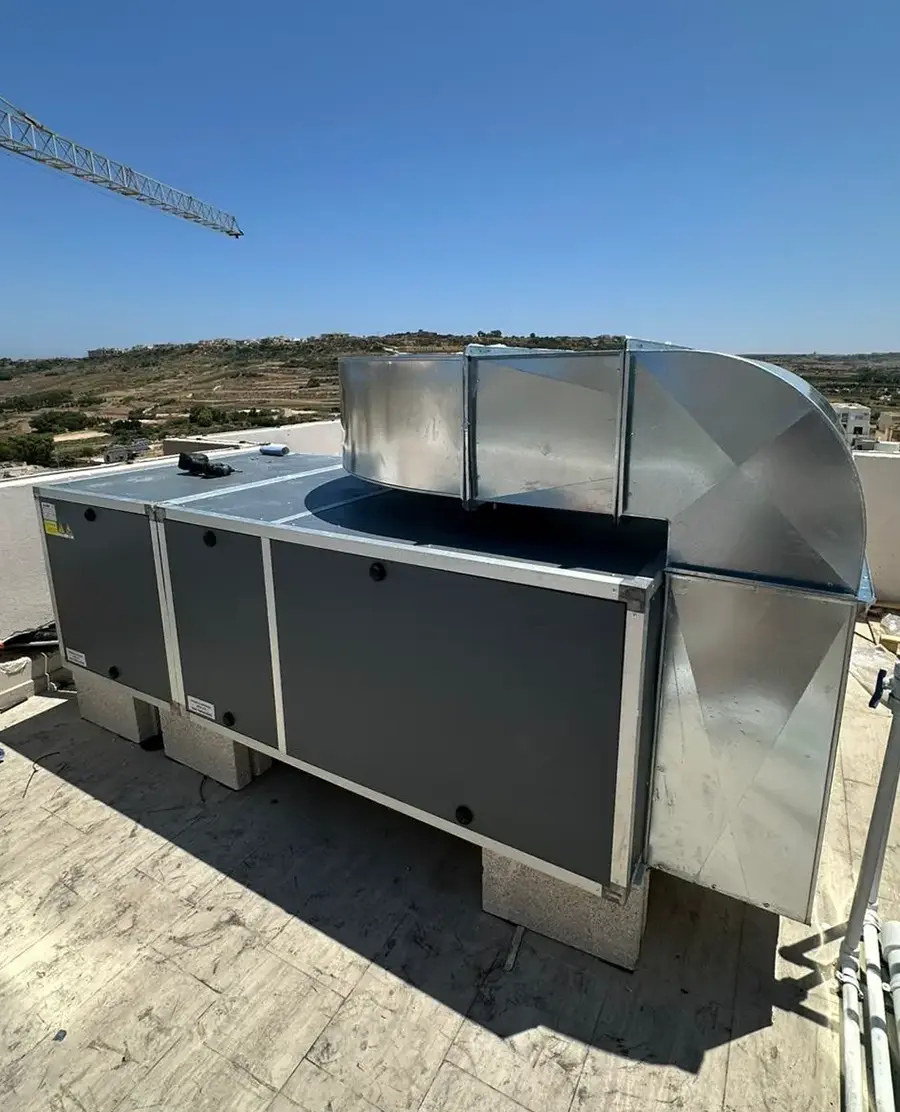
The scope of work covered the full extraction system from canopy to discharge point. A multi-stage air filtration and deodorisation plant was specified and installed, incorporating mesh filters, synthetic filters, bag filters, carbon filters, and electrostatic filtration working in sequence to treat the air at every stage before it reaches the ductwork. This is not a single-filter solution. Each stage targets a different element of the cooking emission: grease particles, fine particulates, and odour are addressed separately and progressively, so that what eventually discharges at roof level meets both regulatory requirements and the practical standards of a building housing residents around the clock.
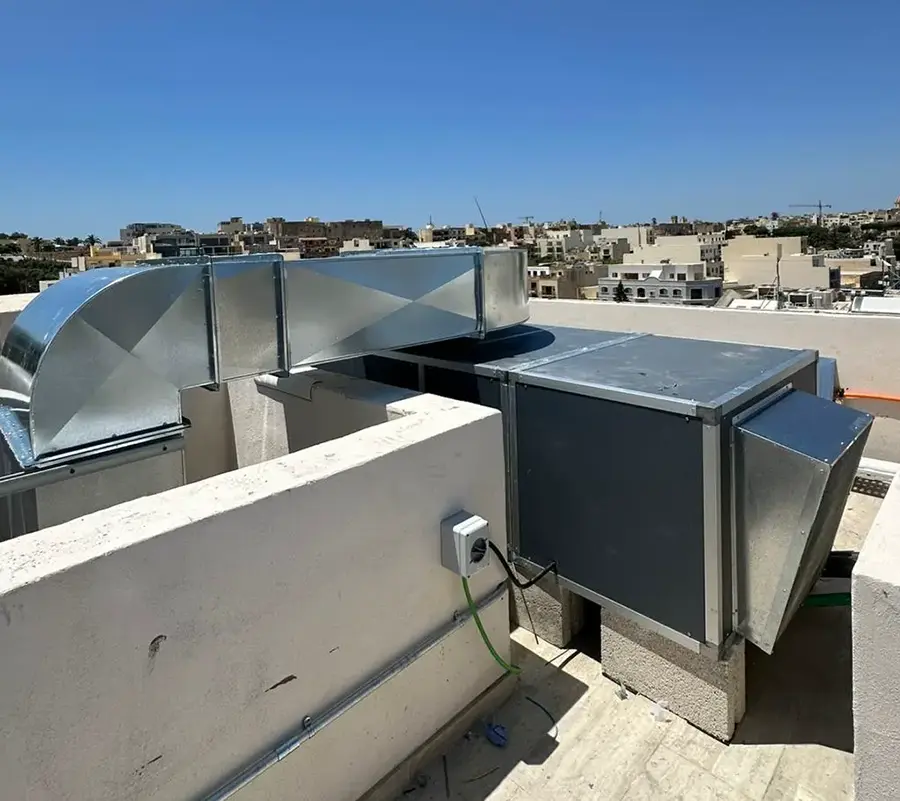
The installation required custom ductwork manufactured to the specific dimensions and routing constraints of the building. On-site airflow testing was carried out to verify performance before sign-off. Custom fittings and dampers were fabricated to connect the kitchen hood to the main ductwork run, and the hood itself was installed complete with those connections. Every element was planned, made, delivered, and fitted by the Spiteri Catering team.
Why old buildings make this harder than it looks
The duct run at a project like Casa Giuseppe does not follow a straight line from kitchen to roof. It navigates floors, structural walls, voids that may or may not exist until the work begins, and surfaces that cannot be damaged. In an occupied care home, the work has to proceed without disrupting residents or compromising the building's day-to-day operation. Planning the route is one skill. Executing it in an old Gozitan building, with all the surprises that brings, is another.
The height alone presents a challenge that operators outside Malta rarely have to consider. A kitchen in a lower ground floor or basement may need its duct run to travel two or three full floors before it reaches roof level and the point of legal discharge. That is a substantial column of fabricated ductwork, custom-fitted to a route that was planned on site, running through a protected building, and terminating in a way that satisfies both the engineer and the planning authority. The materials, the junctions, the fire-rated sections where the duct passes through floor voids, and the external finish where it emerges at roof level: all of it is specified, checked, and installed to the standard the regulations demand.
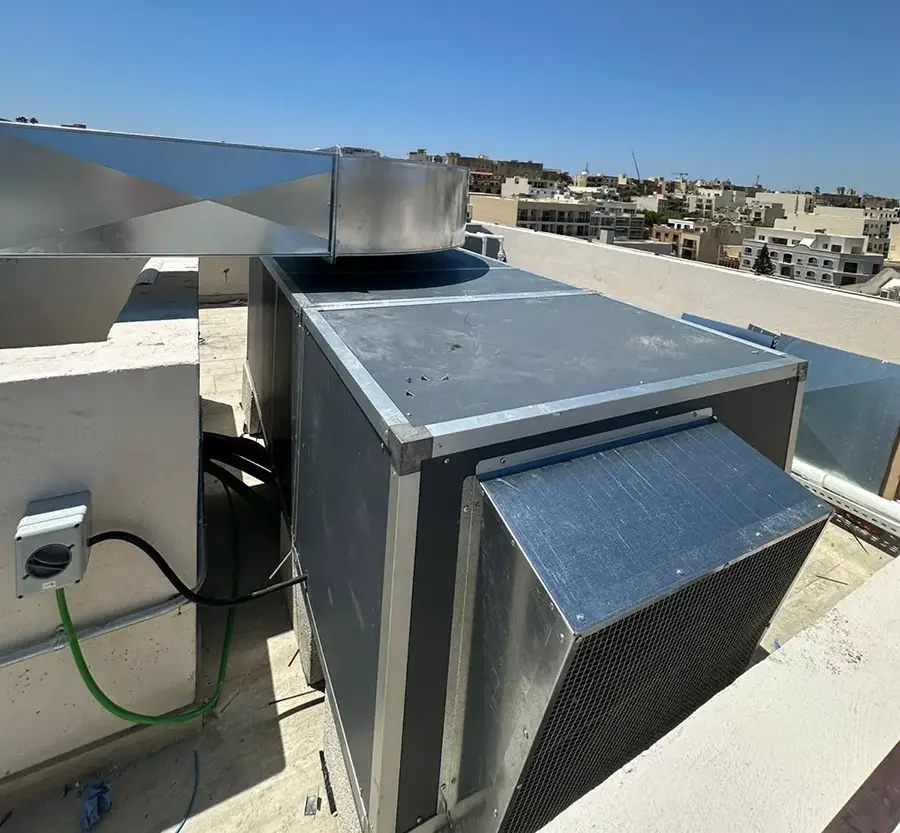
The filtration plant at roof level
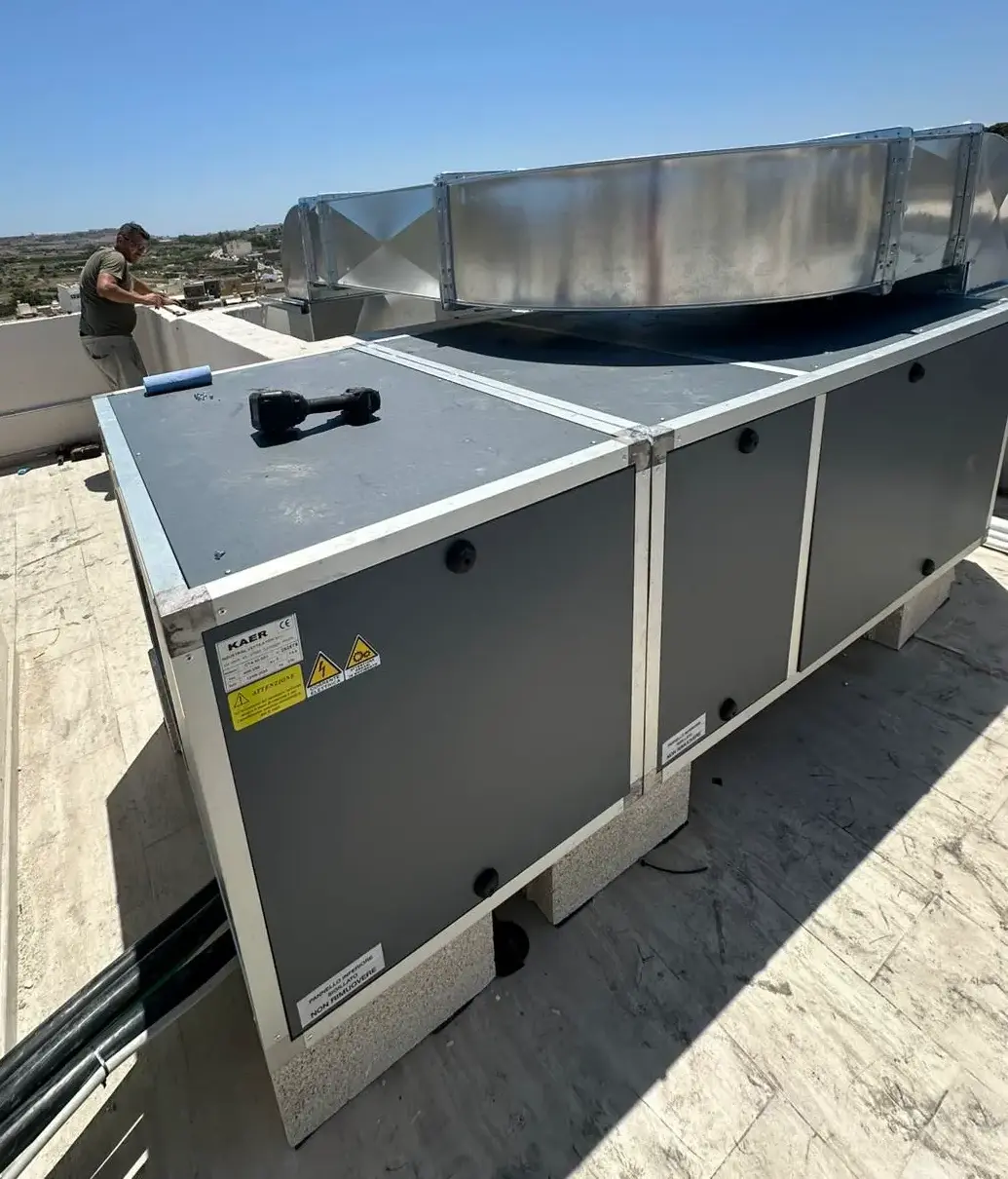
The images show the finished filtration plant as it sits on the roof of Casa Giuseppe: a substantial, precisely fabricated installation of housings, transitions, and curved ductwork components, all custom-made to fit the available space and the routing requirements of the system beneath it. The scale of what sits on that roof is a direct consequence of what the legislation requires and what a care home environment demands.
The multi-stage approach used here reflects the level of treatment that a care home environment requires. Mesh filters at the hood capture larger grease particles at source, protecting the ductwork downstream and reducing fire risk. Synthetic and bag filter stages remove finer particulates from the airstream. Electrostatic filtration addresses the microscopic particles that mechanical filters alone cannot reliably capture. Carbon filtration handles odour, ensuring that the air discharged at roof level is treated to a standard appropriate for a residential environment where the building's occupants are present at all hours.
Working in almost any situation
The honest answer to the question of what makes Maltese extraction work difficult is: almost everything. The buildings were not designed for it. The legislation is exacting. The authorities are thorough. The routes are never straightforward. And the work frequently has to happen in occupied buildings where the margin for disruption is narrow.
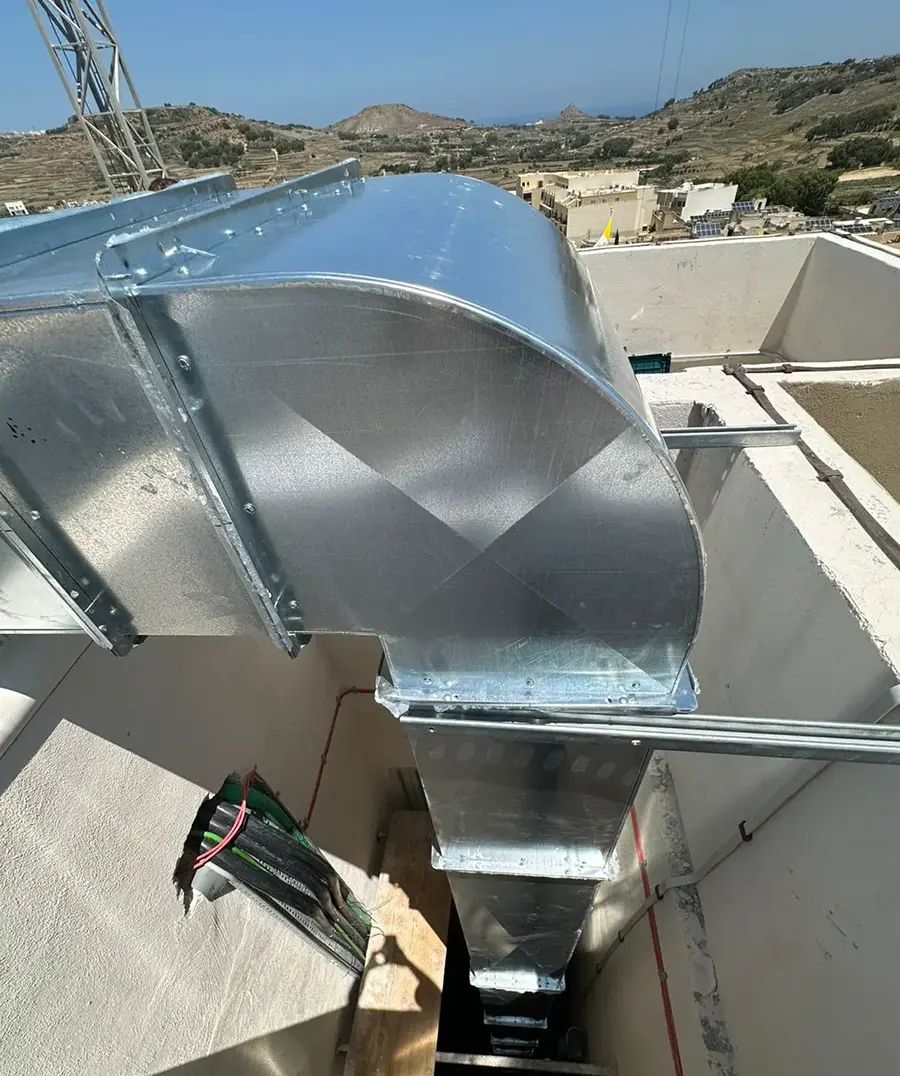
Spiteri Catering has carried out extraction and kitchen design projects across Malta and Gozo in conditions that range from the straightforward to the genuinely complex. The Casa Giuseppe installation sits firmly in the latter category, and the finished system reflects that. It performs to specification, it complies with all applicable regulations, and it does its job in a building where doing the job properly was never going to be simple.
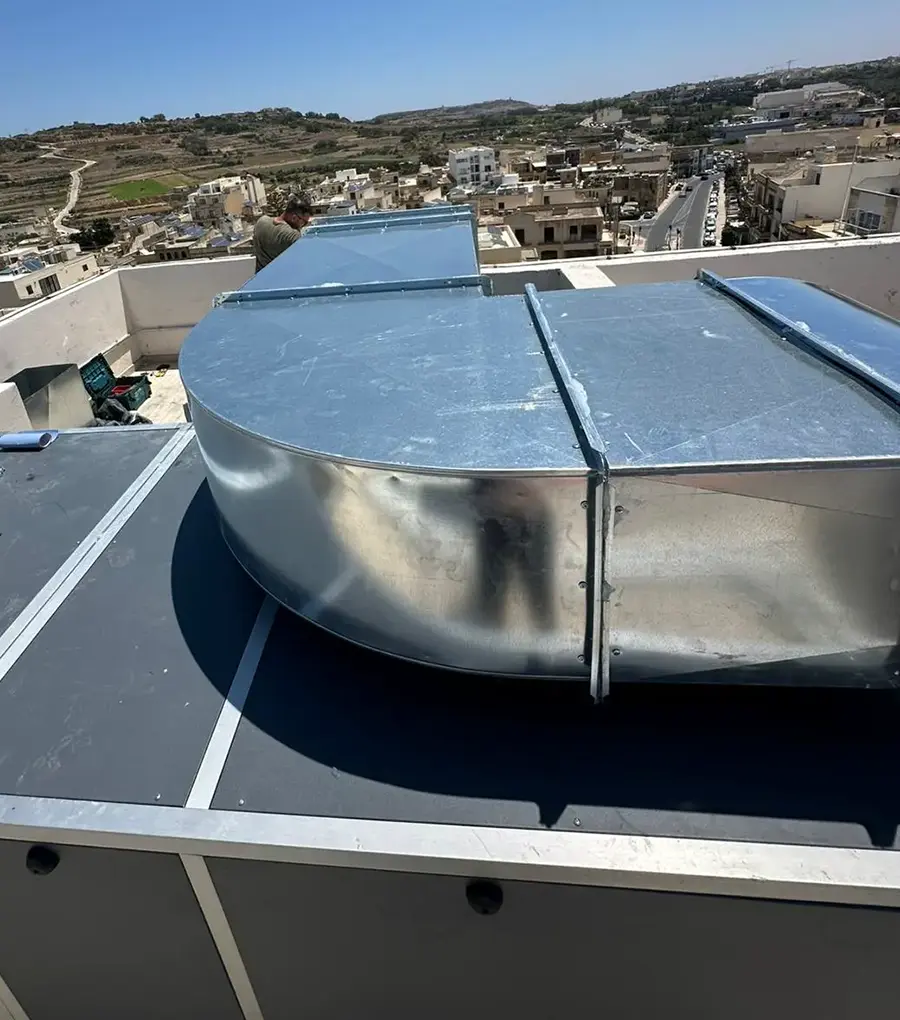
Every extraction project we undertake in Malta is different. The building is always different, the route is always different, and the constraints are always different. What does not change is the standard we work to and the fact that we see the project through from survey to sign-off.
If you are planning a commercial kitchen installation in Malta or Gozo that involves extraction, filtration, or ductwork in a protected or restricted building, we would be glad to talk through what is involved. Get in touch with the Spiteri Catering team and let us understand what you need. We handle everything from initial consultation and design through to supply, professional installation, and ongoing technical support.
Related reading: Why Proper Kitchen Extraction Design Matters | Eight Floors Up: Fitting Out the Cabana Club Kitchen | How to Plan a Commercial Kitchen in Malta