

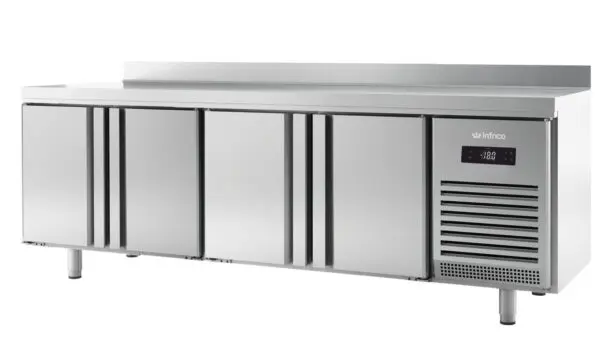
Most kitchens have enough refrigeration to get by. Fewer have refrigeration that is genuinely configured for the work they do. The difference shows up in service: in the time it takes to locate an ingredient, in the temperature a cabinet struggles to hold on a busy Saturday, in the prep counter that never quite keeps pace with the section working above it.
Getting refrigeration right is not simply a matter of buying enough capacity. It is about placing the right type of unit in the right position within the kitchen, specified to the ambient conditions it will face and the workflow it needs to support. In Malta's climate, where ambient temperatures push hard against a cabinet's ability to maintain safe storage temperatures for months at a stretch, that specification matters more than it might in a cooler country.
This guide covers the main refrigeration categories a commercial kitchen needs to consider, what each one is designed to do, and how to think about where each belongs in your layout.
Undercounter refrigeration
Undercounter units sit beneath a work surface and keep refrigerated ingredients within arm's reach of the section that uses them. They are the workhorses of a commercial kitchen: compact, accessible, and positioned exactly where the work happens.
The key consideration here is not capacity but access speed. A chef working a hot section does not want to walk to a remote cabinet mid-service. Undercounter refrigeration shortens that journey to a single movement. Well-placed undercounter units reduce service errors, protect ingredient quality, and keep the kitchen moving at the pace the front of house expects.
For restaurants and hotel kitchens alike, undercounter refrigeration is typically specified as part of the cooking line, sitting beneath or immediately adjacent to the section it serves. Placement during the kitchen design stage, rather than as an afterthought, makes a significant difference to how well it integrates with the workflow above it.
Upright refrigeration cabinets
Upright cabinets handle bulk storage: the stock that is not yet needed on the line but needs to be kept at safe temperature until it is. In a restaurant kitchen, this typically means the main ingredient store. In a hotel kitchen, it often means multiple cabinets serving different departments, from the main kitchen through to the pastry section and the staff feeding area.
Capacity and door configuration are the primary decisions here. Single-door cabinets work well in smaller operations where one person controls access. Double-door and multi-section cabinets allow different sections to work from the same unit without interference. In high-volume environments, the ability to maintain consistent temperature across a full cabinet under repeated door openings is a meaningful performance measure, not a secondary specification point.
Positioning matters too. Upright cabinets belong in or immediately adjacent to the main storage and prep area, not tucked into a corner that adds unnecessary steps to the service flow. Where space is genuinely constrained, a well-specified tall cabinet can replace two or three undercounter units without sacrificing the access that service requires, provided the kitchen layout allows it.
Saladette and prep counters
A saladette is a refrigerated prep counter with an open top section for gastronorm inserts, allowing ingredients to be kept chilled and immediately accessible at the point of assembly. They are standard in any operation producing salads, cold starters, sandwiches, or anything built to order from component ingredients.
For a hotel kitchen running a buffet operation or room service, a well-specified saladette at the cold section can be the difference between a section that flows and one that constantly stalls. For a restaurant, the same principle applies at the garnish station and the cold starter section.
The critical specification point is the top section's ability to maintain safe temperatures in the open position under the heat load of a busy service. In a hot kitchen in summer, that is a harder task than the product specification sheet alone suggests. It is worth discussing actual performance expectations with your supplier before committing to a model.
Display refrigeration
Display units serve two functions simultaneously: they keep product at safe temperature, and they present it. For any operation where food is sold or presented to guests before service, a display cabinet that does both well is not a luxury. It is part of the guest experience.
Patisserie counters, deli displays, grab-and-go units, and open-fronted display refrigerators all fall within this category. The specification questions are different from those that govern back-of-house storage: lighting quality, glass configuration, and the relationship between display visibility and temperature consistency all become relevant in a way they do not for a staff-only cabinet.
Hotel breakfast operations, café service counters, and any venue that presents cold food to guests at point of sale need to think carefully about this category. A cabinet that looks right but struggles to hold temperature during a busy breakfast service is a food safety risk dressed up as a design choice.
Blast chilling
A blast chiller reduces the temperature of cooked food rapidly, taking it through the bacterial danger zone quickly enough to make cook-chill production safe and practical. It is not a storage unit; it is a process unit, and it belongs in the workflow rather than on the periphery of it.
For hotel kitchens producing food in volume, a blast chiller changes what is operationally possible. It allows batch cooking in advance of service, reduces waste from over-production, and extends the usable life of prepared food without compromising safety. For restaurants with smaller teams managing complex menus, the same logic applies at a smaller scale.
The absence of a blast chiller in a kitchen that would benefit from one is often less about cost than about not having thought through the workflow implications. Once a team has worked with one, it tends to become non-negotiable.
Ice machines
Ice is easy to overlook in a refrigeration specification, because it does not feel like refrigeration in the conventional sense. In practice, a kitchen or bar that runs short of ice during service has a serious problem, and one that a correctly specified ice machine prevents entirely.
Ice machine specification is primarily about output volume relative to peak demand, storage capacity, and the space and drainage requirements of the unit itself. In a hotel operation with multiple bars, a restaurant with a busy cocktail programme, or any venue running through the Maltese summer, ice supply is a genuine operational consideration that deserves the same attention as any other refrigeration decision.
How Infrico fits into this
Infrico is a Spanish manufacturer with a broad commercial refrigeration range covering most of the categories above. Their equipment is built for professional use in demanding environments, which makes them a practical fit for the Maltese market where ambient conditions place real pressure on refrigeration performance. We work with Infrico across a range of commercial kitchen projects, from single undercounter units in smaller restaurant refurbishments through to multi-cabinet configurations in larger hotel kitchen installations.
The right Infrico unit for a given kitchen depends on the specific requirements of that space: the layout, the service style, the volume, and the ambient conditions. That is a conversation worth having before any equipment is specified, not after.
Starting with the layout
The most common refrigeration mistake in commercial kitchens is not under-specification. It is misplacement. A high-quality cabinet in the wrong position adds steps, slows service, and frustrates the team that has to work around it every day. Getting placement right means thinking about refrigeration as part of the kitchen layout, not as an equipment purchase that happens separately from it.
Refrigeration decisions made in isolation from the kitchen layout tend to get revisited at considerable cost. The conversations worth having are the ones that happen before the floor plan is fixed.
If you are planning a new kitchen, refurbishing an existing one, or simply reassessing whether your current refrigeration setup is working as hard as it should, we would be glad to talk it through.
Get in touch with the Spiteri Catering team and let us understand what you need. We handle everything from initial consultation and design through to supply, professional installation, and ongoing technical support.
Frequently asked questions
A few of the questions we hear most often when operators are thinking through their commercial refrigeration setup.
How much refrigeration does a commercial kitchen actually need?
There is no single answer, because it depends entirely on your menu, your covers, your storage rhythm, and your kitchen's ambient conditions. The more useful question is whether your current refrigeration is placed correctly for the work it supports. A kitchen can have plenty of capacity and still run into problems if the right unit is not in the right position.
What is the difference between a refrigeration cabinet and a saladette?
A refrigeration cabinet stores. A saladette does both: it stores and it presents ingredients at the point of use, with an open top section for gastronorm inserts that keeps components chilled and immediately accessible during service. They serve different functions and most professional kitchens need both.
Do I need a blast chiller if I run a small restaurant?
Possibly, yes. The case for a blast chiller is not purely about volume; it is about workflow. If your kitchen batch cooks in advance of service, manages a complex menu with a small team, or wants to reduce waste from over-production, a blast chiller changes what is operationally possible. The question is whether your current workflow would benefit from cook-chill production, not simply how many covers you serve.
How does Malta's climate affect commercial refrigeration specification?
Significantly. Ambient temperatures in a Maltese commercial kitchen during summer place real pressure on any refrigeration unit's ability to maintain safe storage temperatures. Equipment that performs adequately in a northern European kitchen may struggle here. It is worth specifying units rated for high ambient conditions and discussing actual performance expectations with your supplier before committing to a model.
Where should I start if I am planning a new commercial kitchen refrigeration setup?
Start with the layout, not the equipment list. Refrigeration placed in the wrong position adds steps, slows service, and frustrates the team working around it every day. The most productive conversation to have is one that looks at your kitchen's workflow, section by section, before any unit is specified. That is exactly the kind of conversation the Spiteri Catering team is set up to have.
Related reading: How to Plan a Commercial Kitchen in Malta | No Two Cold Rooms Are the Same | Getting Your Commercial Kitchen Ready for Summer