
TL;DR: A vacuum packing station is not a luxury reserved for high-end kitchens. It is a practical piece of kitchen infrastructure that handles portioning, marinating, sous vide preparation, end-of-service sealing, and cold storage efficiency. The Henkelman range covers operations from small restaurants through to high-volume production kitchens.
Every well-run commercial kitchen is built around defined stations. Prep. Cooking. Pass. Dishwash. Each one has a purpose, a position in the workflow, and a team member responsible for it. Together they give the kitchen its structure: work moves through in a sequence, nothing waits unnecessarily, and the people inside it know exactly where they are in the process at any moment.
Most kitchens stop at four. The fifth station, the one that high-performing operations have quietly built into their workflow, rarely appears on a floor plan. It does not have a burner or a basket or a drainage point. What it has is a chamber, a lid, and a pump that removes up to 99.8% of the air from a sealed bag before the kitchen does almost anything else.
What the vacuum station actually does
The case for vacuum packing is often made in terms of shelf life, and shelf life is real and significant. But reducing the argument to preservation undersells what the station contributes to a working kitchen.
Consider what passes through a well-used vacuum machine in a single week. Proteins portioned and sealed at the start of prep, labelled and stacked cleanly in the cold room rather than sitting exposed on a tray. Marinades applied under vacuum, where the absence of air forces the liquid into the meat in a fraction of the time a conventional soak would take. Sauces and stocks sealed at the end of service rather than decanted into containers that will lose quality overnight. Batch-cooked elements prepared in advance, sealed to retain their integrity, and regenerated to order during service rather than cooked from raw.
The vacuum station connects tasks that most kitchens handle separately and less well: portioning, marinating, sous vide, end-of-service sealing, and cold storage management. When those tasks run through a single station, the kitchen becomes measurably more organised.
Then there is sous vide. The technique depends entirely on the vacuum station: without a properly sealed bag, there is no sous vide. The benefits of cooking sous vide, consistent internal temperatures, full flavour and moisture retention, portions that hold at exactly the right point until the moment they are needed, flow directly from the quality of the seal. A chamber machine that achieves a genuine commercial vacuum makes this possible. A domestic strip sealer does not.
At the end of the day, the station earns its place again. Proteins that did not go to the pass. Prepped garnishes. House-made condiments. All of it sealed rather than wrapped, protected rather than stored. The cold room the following morning looks different in a kitchen with a vacuum station: tighter, more organised, less waste on the tray edges.
There is also a practical storage point worth making plainly: vacuum-sealed portions stack. Trays do not. In a Maltese commercial kitchen, where cold room space is rarely generous, the efficiency gains from sealed flat packs add up quickly.
Chamber machines and strip sealers are not the same thing
This is worth stating directly, because many operators who have not yet committed to a professional vacuum station have a domestic or semi-professional strip sealer somewhere in the kitchen and are not sure what the real difference is.
A strip sealer works by drawing air from a pre-formed bag and sealing it at the opening. It achieves a partial vacuum. It works reasonably well for short-term storage and basic portioning, and it is inexpensive to buy.
A chamber vacuum machine works differently. The product, bag and all, sits inside a sealed chamber. The machine evacuates the entire chamber before sealing, which means the vacuum achieved inside the bag is far more complete. Henkelman's machines reach up to 99.8% air removal. That figure matters because residual oxygen is what drives spoilage, bacterial growth, and oxidation. The lower the residual oxygen, the longer the product retains its quality.
The difference between a chamber machine and a strip sealer is not a matter of degree. It is a difference in method. A chamber machine evacuates the entire sealed environment; a strip sealer draws from the opening only. For sous vide, marinating, and any application where the integrity of the seal is critical, only a chamber machine delivers consistent results.
The other difference is durability and throughput. A professional chamber machine is built to run. Henkelman's tabletop models are rated for up to five hours of daily use; their floor-standing and double-chamber machines for up to eight. A strip sealer in a commercial kitchen is not designed for that kind of sustained work, and its results are not consistent enough for sous vide, where the integrity of the seal is the foundation of the technique.
Matching the machine to the operation
The Henkelman range runs from compact tabletop models through to double-chamber floor machines, and the right choice depends on one thing above all others: how much the station actually works.
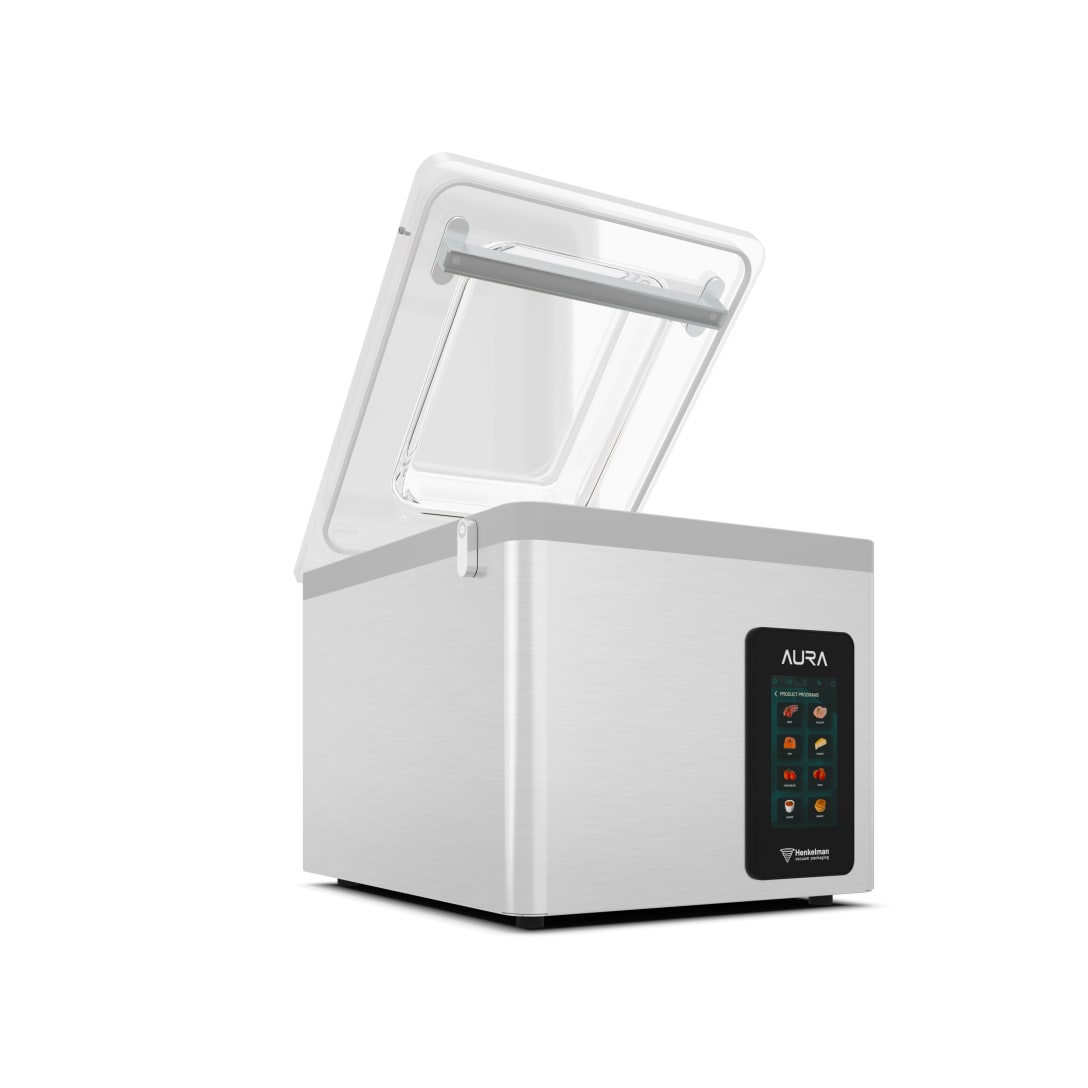
For smaller restaurants, cafés, and hospitality operations where the vacuum station is used regularly but not continuously, a tabletop machine is a practical starting point. Models such as the Aero, designed for use in open kitchens and on counter tops, and the Aura, which offers an extensive library of pre-set programmes, both sit comfortably on a prep bench without dominating the space. The Advanced Control System available across the range brings features including marinating and step vacuum functions, which extend what the machine can do well beyond basic sealing.
Choosing the right Henkelman model is not primarily a question of budget. It is a question of throughput: how many hours a day will the station run, and what tasks will it be asked to handle? The answer to that question points clearly to the right tier of machine.
For busier restaurant, hotel, and catering kitchens where the station runs for longer periods and handles a greater variety of tasks, a floor-standing single-chamber machine offers the chamber depth and pump capacity to match. Models such as the Polar Single Chamber and the Marlin sit in this category: robust, fully stainless steel construction in the case of the Polar, and a deep chamber with a transparent lid on the Marlin, which is particularly useful when packing larger or irregular products.
For high-volume operations where throughput is the governing constraint, the double-chamber machines change the dynamic entirely. One chamber seals while the other is being loaded. There is no cycle-and-wait. For a production kitchen, a catering operation preparing large volumes in advance, or a hotel kitchen running continuous prep shifts, the double-chamber format is not an upgrade; it is a different kind of machine.
The station as infrastructure
The kitchens that get the most from a vacuum station are not necessarily the ones doing the most technically complex cooking. They are the ones that have decided to treat the machine as infrastructure rather than a piece of equipment that gets used occasionally.
That decision changes behaviour. It changes how prep is organised, how purchasing is scheduled, how the cold room is managed, and how much of the previous day's work survives intact to the following service. The machine does not make those decisions; the team does. But the machine makes them possible.
A kitchen without a vacuum station is not necessarily a kitchen in trouble. It is a kitchen that is doing the same work with more effort, more waste, and less consistency than it needs to.
If you would like to know more about the Henkelman range or discuss whether a vacuum packing machine is the right fit for your kitchen, we would be glad to help. Spiteri Catering covers initial consultation and design, professional installation, and technical support across our full equipment range. Get in touch with the Spiteri Catering team to start the conversation.
Frequently asked questions
Can a vacuum machine handle liquids like soups and sauces?
Yes, with the right machine and the right option fitted. Reducing the pressure in a vacuum chamber causes cold liquids to boil, which can contaminate the chamber and damage the pump if not managed correctly. Henkelman's Liquid Control option detects evaporation as it occurs and stops the vacuuming cycle before the liquid reaches boiling point, sealing at the optimum moment. This makes it practical to vacuum-pack soups, sauces, and stocks without risk to the machine.
What is the difference between a tabletop and a floor-standing machine?
The main differences are chamber size, pump capacity, and rated daily use. Tabletop models are compact and suited to operations with moderate throughput, rated for up to around five hours of daily use. Floor-standing models have deeper chambers, more powerful pumps, and are rated for up to eight hours of daily use. For operations handling larger portions or running the station heavily throughout the day, a floor-standing model is the more appropriate choice.
Does a vacuum machine work for sous vide cooking?
Yes, and in a professional kitchen the two are closely linked. Sous vide requires a bag sealed to a genuine commercial vacuum level to achieve consistent results. A professional chamber machine achieves this reliably; a domestic strip sealer does not. Henkelman machines support sous vide across the range, and the Liquid Control option extends this to liquid-rich preparations including soups and sauces.
How much space does a vacuum station need?
A tabletop model requires a clear bench area of roughly half a metre in width with adequate ventilation around the machine. Floor-standing models occupy a modest footprint, comparable to a small undercounter refrigerator. Henkelman also offers a stainless steel trolley accessory for their tabletop models, which adds storage below the machine and gives it mobility within the kitchen if bench space is the constraint.
Is vacuum packing only relevant to high-end or large kitchens?
No. The operational benefits, reduced waste, consistent portion quality, more efficient cold storage, and faster marinating, apply to any commercial kitchen that prepares food in advance and manages ingredients across multiple service periods. The entry point in the Henkelman range is accessible for smaller operations, and the throughput gains tend to be proportionally larger in kitchens where prep time is limited.
Related reading: What Goes Where: Choosing the Right Refrigeration for Your Commercial Kitchen | How to Plan a Commercial Kitchen in Malta | Getting Your Commercial Kitchen Ready for Summer