

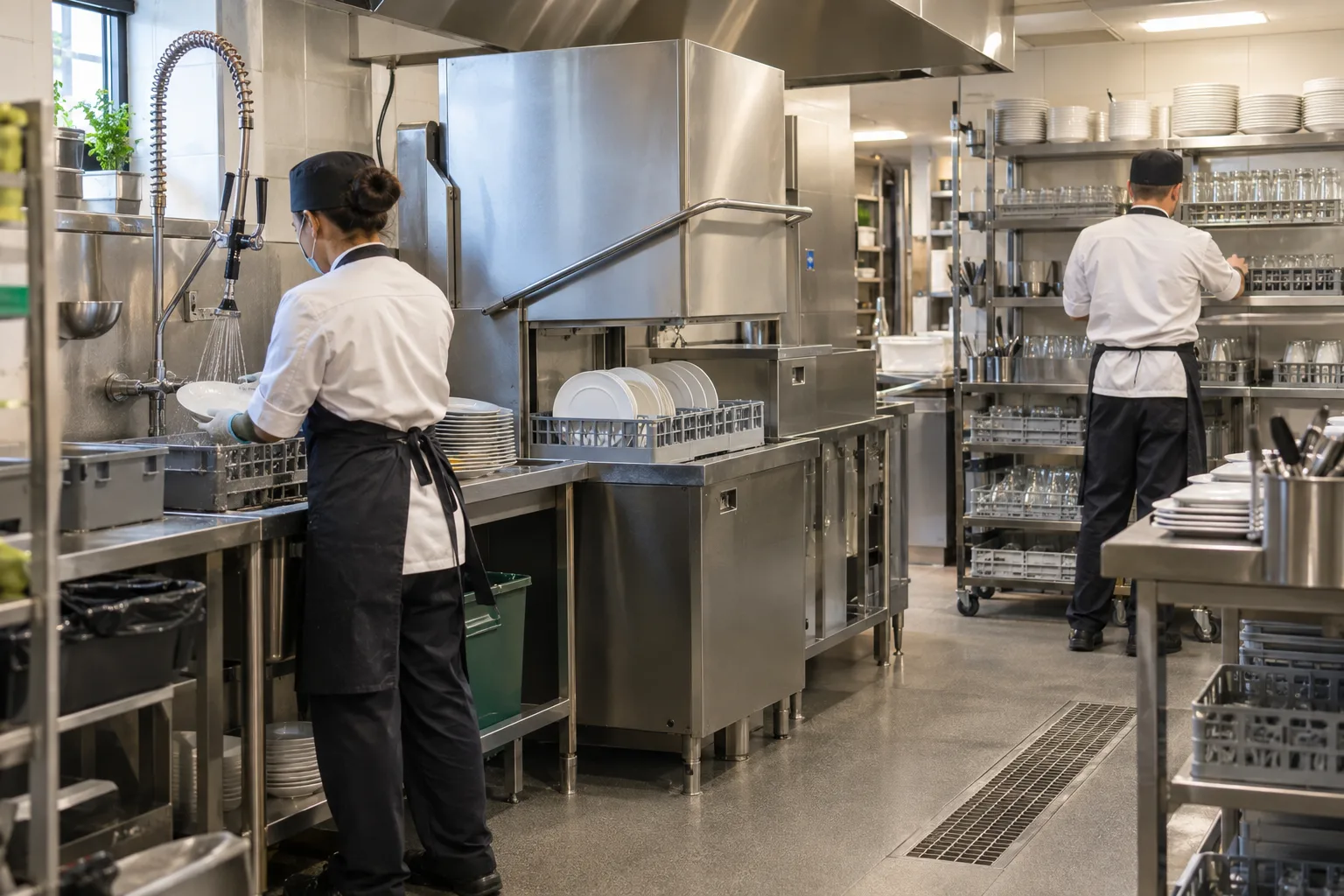
The dining room is full, the pass is moving, and the next table needs plates. At the same time, dirty crockery is arriving faster than the wash area can clear it. Racks are stacking up, clean items have nowhere to dry, and staff are crossing one another with hot plates and wet glassware.
At that point, the dishwasher may be working perfectly. The problem is the area around it.
A commercial dishwashing area is not simply a machine beside a sink. It is a production line with a dirty end, a clean end and a fixed amount of work to process during the busiest part of service. When that line is planned properly, crockery returns smoothly, staff know where each item goes, and clean ware reaches the kitchen or front of house without crossing the dirty route. When it is not, the wash area becomes a bottleneck that affects the whole operation.
The right dishwasher matters, but it cannot correct a workflow that sends dirty and clean items through the same space.
Start with the complete route, not the machine
The useful starting point is to follow a plate from the moment it leaves the guest's table until it is ready to be used again. In most operations, that route includes:
- Dirty return from the dining room, bar or kitchen.
- Sorting and removal of food waste.
- Scraping or pre-rinsing.
- Loading into the correct rack.
- Washing and rinsing.
- Draining and air drying.
- Clean storage or redistribution.
Each stage needs enough working space for the volume arriving at peak service, not just for a quiet hour. If one stage is missing or undersized, staff create an improvised version of it. A trolley becomes a dirty return table. The edge of a sink becomes a rack store. Freshly washed plates are stacked before they have drained. Those workarounds soon become the normal process, even though they slow the operation and add unnecessary handling.
When we plan a commercial kitchen, we look at this route as part of the wider service flow. The wash area must connect sensibly to the dining room, bar, pass and clean storage without turning a busy circulation route into a queue.
Keep the dirty and clean sides genuinely separate
The basic principle is straightforward: dirty items should enter on one side of the machine and clean items should leave on the other. In practice, maintaining that separation depends on the tables, sinks, racks, shelves, doors and staff routes around the dishwasher.
A hood-type passthrough machine works well when it forms the centre of a clear left-to-right or right-to-left process. Dirty racks arrive at the inlet table, pass through the machine and leave onto a separate clean table. An undercounter machine can support the same principle, but its smaller footprint makes it even more important to provide defined landing space on both sides.
Avoid making the clean operator reach across the dirty return area for racks, chemicals or storage. Do not place clean crockery where spray from the pre-rinse station can reach it. If the same doorway is used for dirty returns and clean redistribution, allow enough width and visibility for staff to pass without collisions.
This is not about making a compact kitchen behave like a large hotel. It is about making the direction of travel obvious, even where space is limited.
Give dirty returns somewhere deliberate to land
Dirty items rarely arrive at a perfectly even rate. They arrive in waves: after a breakfast sitting, when several tables leave together, between banquet courses or during the final push at the end of service. The return area needs enough buffer capacity to absorb those waves without blocking the route.
Plan where plates, cutlery, glasses, trays, pots and food waste will go before they reach the machine. Sorting at the return point reduces handling later and helps protect fragile items. A glass placed beneath a stack of plates is unlikely to enjoy the experience.
Waste bins should be convenient to use but should not obstruct feet, doors or rack movement. Scraping and pre-rinsing need a suitable sink or station, a professional pre-rinse spray where appropriate, and splash control. The operator should be able to move from sorting to racking without turning repeatedly or carrying dripping items across the floor.
Size the machine around peak throughput
Machine capacity is often discussed as racks per hour. That figure is useful, but it is only part of the calculation. The real question is how many racks the operation must process during its busiest sustained period, what those racks contain and whether staff can load, unload and return them at the same pace.
Count the crockery generated by the menu and service style. A cafe serving drinks and light food has a different pattern from a restaurant turning several courses, a hotel clearing breakfast, or a banqueting operation handling hundreds of place settings within a short window. Include kitchen utensils, gastronorm containers and preparation equipment if they will use the same wash area.
An undersized machine creates queues and repeated handling. An oversized machine can use more space, water and energy than the operation needs. Our guide to what a commercial dishwasher actually costs to run explains why throughput, water, energy and labour need to be considered together.
Rack capacity matters as well. There must be enough of the correct racks in circulation, plus somewhere sensible to store empty racks. A fast machine is of little help if every rack is already waiting under a table or being used for clean storage.
Plan glasswashing around where glasses are produced
Glassware does not always belong in the main dishwashing stream. Bars, cafes and hotel breakfast areas may produce glass volume in a different location and at a different pace from kitchen crockery. Sending every glass through a distant back-of-house wash area adds travel, increases breakage risk and delays its return to service.
A dedicated glasswasher near the bar can be the better solution where volume justifies it. It also allows the operation to use suitable racks, wash pressure and handling for glassware. Clean glasses still need time and space to drain and air dry before polishing or storage. Our article on keeping professional glassware clear and presentable looks at the care side in more detail.
Do not treat drying and clean storage as spare space
The cycle finishing does not mean the process is finished. Crockery and glassware need a clean landing area where they can drain and dry without being stacked too quickly or returned through the dirty zone.
Allow enough outlet table length for at least the number of racks likely to leave the machine before staff can redistribute them. Position clean shelving close enough to reduce carrying, but not so close that it collects steam, spray or contamination from dirty returns. Shelves and trolleys should suit the items being stored, with heavier pieces at a safe working height and fragile items protected from busy circulation.
If clean ware repeatedly accumulates beside the machine, the problem may not be dishwasher speed. The redistribution route, staffing pattern or storage position may be the actual constraint.
Design for the people doing the work
Dishwashing is repetitive physical work. Table heights, rack weight, reach distance and turning space affect how tiring it becomes over a shift. Staff should not need to lift full racks from floor level, twist around an open machine door or carry wet crockery through a narrow crossing route.
Passthrough tables, roller sections and correctly positioned rack storage can reduce lifting. Rounded routes and adequate aisle width help staff move safely when the floor is busy. Anti-slip flooring, effective drainage and prompt control of splashes matter because water will reach the floor, even in a well-run area.
Noise and heat matter too. Dishwashing placed directly beside a preparation position or open pass can add avoidable heat, humidity and cycle noise to an already demanding environment. This connects directly with the wider relationship between kitchen design and staff wellbeing.
Coordinate water, drainage, power and ventilation early
A dishwasher cannot be positioned properly if the services are treated as an afterthought. Confirm the machine's electrical load, hot or cold water requirement, water pressure, drainage arrangement, chemical dosing and any water-treatment requirement before finalising the layout.
Malta's hard water makes appropriate treatment and a disciplined maintenance routine especially important. Scale affects heating, wash quality, chemical use and reliability. The machine must also remain accessible for daily cleaning and professional servicing. Leaving no route to a filter, dosing container or service panel turns a routine task into a much larger job.
Dishwashers release heat and moisture into the room. The extraction and ventilation strategy should account for the selected equipment, the room volume and the intensity of use. A hot, humid wash area is uncomfortable for staff and can create condensation on nearby finishes and storage. These requirements should be coordinated with qualified professionals and the equipment manufacturer's instructions rather than guessed after installation.
Choose equipment as part of the layout
There is no single machine format that suits every operation. A compact undercounter dishwasher may be exactly right for a cafe or smaller restaurant with controlled throughput. Our overview of the Krupps KE50UT undercounter dishwasher shows how a professional machine can fit a compact operation when its capacity matches the demand.
Higher-volume restaurants, hotels and function operations may need a hood-type passthrough machine with inlet and outlet tables, or a larger automated system where the numbers justify it. The specification should follow the volume, item mix, available space, utilities and staffing plan. It should not begin and end with the dimensions of the empty gap beside the sink.
Whichever format is selected, daily access matters. Filters, wash arms and internal surfaces must be straightforward for trained staff to inspect and clean. Our dishwasher and glasswasher maintenance guide covers the routines that protect wash quality and equipment life once the area is operating.
Plan for the busiest twenty minutes
An average daily total can conceal the real design problem. Four hundred covers spread evenly across ten hours are very different from four hundred place settings returning in concentrated waves.
Walk through the peak period before approving the plan. Ask:
- Where do dirty items wait when several tables clear together?
- Can food waste, cutlery, crockery and glasses be sorted without blocking returns?
- How many racks are needed in circulation at peak demand?
- Can one member of staff operate the area safely, and what changes when a second joins?
- Where do clean racks drain, dry and wait for collection?
- Does clean redistribution cross the dirty route?
- Can the machine be cleaned and serviced without dismantling the surrounding workspace?
- What happens if a rack, trolley or bin is temporarily left in the aisle?
This simple exercise often reveals more than a discussion based only on equipment dimensions.
A good wash area protects the whole service
The dishwashing area sits at the end of one service cycle and the beginning of the next. If it falls behind, the effects travel quickly: the kitchen runs short of plates, the bar waits for glasses, staff make extra journeys, and clean and dirty items begin competing for the same space.
A well-planned area does something quieter. It keeps the route obvious, gives each stage enough capacity and lets the selected equipment perform as intended. Staff spend less time working around the layout, crockery receives fewer knocks, and the rest of the operation can concentrate on service.
Spiteri Catering plans, supplies and installs professional dishwashing equipment for restaurants, hotels and catering operations across Malta and Gozo. If you are designing a new wash area or trying to understand why an existing one keeps falling behind, contact our team. We can assess the volume, workflow, available services and space before recommending the equipment and layout that suit the operation.
Related reading: What Your Dishwasher Is Actually Costing You | Why Maltese Caterers Are Turning to the Krupps KE50UT Dishwasher | Essential Maintenance for Your Glasswasher and Dishwasher | Crystal Clear: How to Keep Glassware Sparkling